Teams › Fukuoka SoftBank Hawks: Complete Team History
The Fukuoka SoftBank Hawks are one of the great winning machines in baseball. In one stretch, they won the Japan Series four years in a row.
But the team did not start in Fukuoka. It did not start with SoftBank either. It began as the Nankai Hawks, a train company’s team in Osaka. It spent fifty years there. Then it moved across the country.
This page tells the whole story. We start in 1938. We go through Osaka and the move to Fukuoka. We cover Sadaharu Oh’s years as manager. Then we get to the big title run. At the end, there is a timeline.
Here’s the thing. The Hawks have had three owners, two home cities, and four ballparks. Through all of it, they kept the same name: Hawks.
If you are new to how the leagues work, read how NPB works first. All twelve clubs are on our teams page.
Quick Facts
- League: Pacific League.
- City: Fukuoka, on the island of Kyushu.
- Founded: February 22, 1938.
- First name: Nankai.
- Owner: SoftBank, a phone and tech company, since 2005.
- Home parks: Osaka Stadium (1950 to 1988). Heiwadai Stadium in Fukuoka (1989 to 1992). Fukuoka Dome (1993 on).
- Japan Series titles: 12 (through 2025).
- League titles: 23 (through 2025). That counts 2 from the old single league and 21 in the Pacific League.
- Mascot: Harry Hawk.
- Fight song: “Iza Yuke Wakataka Gundan.”
How the Team Began
The Nankai train company ran lines south from Osaka. In the 1930s, other train companies already had pro teams. Hanshin had the Tigers. Hankyu had the Braves.
Nankai wanted one too. On February 22, 1938, it started a team. It joined the league that fall.
The team was not very good at first. Then, in 1939, a young infielder named Kazuto Tsuruoka joined. He led the league in home runs in his first year. He would later become the most important person in team history.
Names and Owners Over the Years
- 1938 to 1944: Nankai.
- 1944: Kinki Nippon. During the war, train companies were merged. The team took the new company’s name.
- 1946 to 1947: Great Ring. After the war, the team needed a new name for a while.
- 1947 to 1988: Nankai Hawks.
- 1989 to 2004: Fukuoka Daiei Hawks. A supermarket chain called Daiei bought the team and moved it to Fukuoka.
- 2005 on: Fukuoka SoftBank Hawks. SoftBank bought the team.
Daiei had money trouble in the early 2000s. It had to sell the team. SoftBank, led by Masayoshi Son, bought it for the 2005 season.
Home Parks
Osaka Stadium. In 1950, Osaka Stadium opened in the busy Namba area of Osaka. It was small and steep. The stands were close to the field. It was the Hawks’ home for nearly forty years.
Heiwadai Stadium. When the team moved to Fukuoka in 1989, it played at Heiwadai. That was the old home of the Nishitetsu Lions. It was an old park.
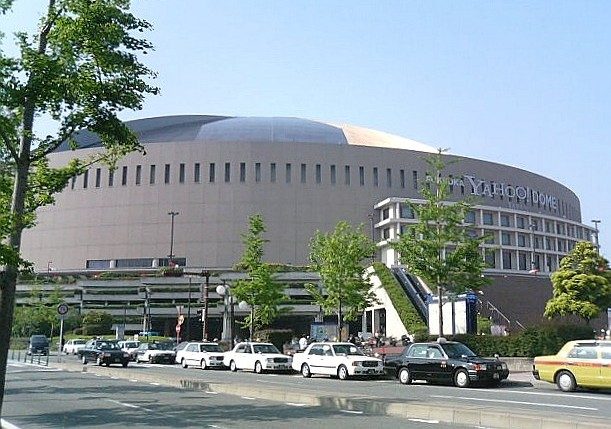
Fukuoka Dome. In 1993, the Hawks moved into the new Fukuoka Dome. It was the first ballpark in Japan with a roof that opens and closes. It has also carried sponsor names, such as Mizuho PayPay Dome Fukuoka. Since the move, the Hawks have drawn the biggest crowds in their league almost every year.
The Single-League Years: 1938 to 1949
The team won its first title in 1946, as the Great Ring. It won again in 1948 as the Nankai Hawks.
Tsuruoka was the player-manager. He played and ran the team at the same time.
The Tsuruoka Era: 1950 to 1968
In 1950, the league split in two. The Hawks joined the Pacific League.
Tsuruoka managed the Hawks for 23 seasons in all. He won 1,773 games as a manager. That is the most in Japanese baseball history.
His teams were very good. In the early 1950s, they had a great infield. People called it “the million-dollar infield.”
They won the pennant in 1951, 1952, and 1953. Each time, they met the Yomiuri Giants in the Japan Series. Each time, the Giants won. The Hawks won again in 1955. The Giants beat them again.
It was a hard pattern. The Hawks were great in their league. But they could not beat Tokyo.
1959: Sugiura’s Four Wins
In 1958, a college star named Tadashi Sugiura joined the Hawks. He was a side-arm pitcher. He was quiet and tough.
In 1959, Sugiura won 38 games. The Hawks won the pennant. And once again, they faced the Giants in the Japan Series.
This time was different. Sugiura pitched in all four games. He won all four. The Hawks swept the Giants. It was their first Japan Series title. Fans in Osaka filled the streets for a parade.
Nomura and the 1960s
The Hawks also had a catcher named Katsuya Nomura. He came to the team in 1954 as a tryout player. Almost no one expected much from him.
He became one of the best players ever in Japan. In 1965, he won the Triple Crown. That means he led the league in batting average, home runs, and RBIs. He was the first to do it since the war. He hit 657 home runs in his career.
The Hawks won pennants in 1961, 1964, 1965, and 1966.
In 1964, they met the Hanshin Tigers. Both teams were from the Osaka area. An American pitcher named Joe Stanka threw shutouts in Games 6 and 7. The Hawks won their second Japan Series. Read the Tigers side on our Hanshin Tigers history page.
In 1961, 1965, and 1966, the Giants beat them again.
Nomura the Manager
In 1970, Nomura became the player-manager. He caught, he hit, and he ran the team.
In 1973, the Pacific League used a split season. The first half winner played the second half winner for the pennant. The Hawks won the first half. Then they beat the Hankyu Braves in a playoff. It was a pennant.
In the Japan Series, they lost to the Giants. It was the last title of the Giants’ nine in a row.
Nomura was let go after the 1977 season. He later became a great manager for the Swallows. See our Yakult Swallows history page.
The Lean Years and the Move
After Nomura left, the Hawks went downhill. They did not have a winning season for twenty years.
But they had a great slugger. Hiromitsu Kadota was a short, powerful hitter. He hit 567 home runs. In 1988, at age 40, he hit 44 homers and won the league MVP.
In 1988, Nankai sold the team to Daiei. The team moved to Fukuoka for 1989.
Fukuoka had lost its pro team ten years earlier. The Lions had left for Saitama. Now the city had a team again. See our Seibu Lions history page for that story.
Oh Takes Over: 1995 to 2008
In 1995, Sadaharu Oh became the manager. He was the world’s all-time home run king. He had played for the Giants.
The start was rough. In 1996, angry fans threw raw eggs at the team bus. Oh did not quit. He kept building.
The team added stars. Kimiyasu Kudoh came from the Seibu Lions. Koji Akiyama came from Seibu too. Young players grew up.
- Hiroki Kokubo was a power-hitting infielder.
- Kenji Johjima was a catcher who could hit. He later played for the Seattle Mariners.
- Tadahito Iguchi was a fast, strong second baseman. He later won a World Series with the Chicago White Sox.
- Nobuhiko Matsunaka won the Triple Crown in 2004. See the 2004 title holders page.
- Kazumi Saito won 20 games in 2003.
In 1999, the Hawks won the pennant. They beat the Chunichi Dragons in the Japan Series. It was their first title in 35 years, and their first in Fukuoka.
In 2000, they won the pennant again. They faced the Giants in the Japan Series. People called it the “ON series.” Oh ran the Hawks. His old teammate Nagashima ran the Giants. The Giants won.
In 2003, the Hawks beat the Hanshin Tigers in seven games. That was their fourth Japan Series title.
Oh managed the Hawks through 2008. In 2006, he also managed Japan to the first World Baseball Classic title.
The SoftBank Years Begin
SoftBank took over in 2005. It spent money to build a strong team. It also built a big system for young players. Some of the best Hawks stars started as “development players.” These players sign for very little. They wear big numbers, like 120 or 130.
Kodai Senga was one of them. He became an ace. He later pitched for the New York Mets. Catcher Takuya Kai was another. He was famous for his strong arm. Fans called it the “Kai Cannon.”
Koji Akiyama, Oh’s old star, became the manager in 2009. The Hawks won the pennant in 2010 and 2011. In 2011, they beat the Dragons in the Japan Series. In 2014, they won it all again, over the Tigers.
Four in a Row: 2017 to 2020
Kimiyasu Kudoh became the manager in 2015. He had won many titles as a pitcher. As a manager, he did even better.
- 2015: Pennant. Beat the Swallows in the Japan Series.
- 2017: Pennant. Beat the BayStars.
- 2018: Second place. Won the playoffs. Beat the Carp.
- 2019: Second place. Won the playoffs. Swept the Giants.
- 2020: Pennant. Swept the Giants again.
That made four Japan Series titles in a row, from 2017 to 2020. Only the Giants of the V9 years have won more in a row.
Stars of those teams included:
- Yuki Yanagita, a big, fast outfielder. He did a “triple three” in 2015. That means .300, 30 homers, and 30 steals. He won two batting titles. See the batting average title holders page.
- Seiichi Uchikawa, a smooth hitter who joined in 2011.
- Nobuhiro Matsuda, a cheerful third baseman.
- Alfredo Despaigne, a Cuban slugger.
- Dennis Sarfate, a closer. He saved 54 games in 2017. That is the most in one season in Japan.
- Tsuyoshi Wada and Toshiya Sugiuchi, two star lefties.
2024 and 2025
In 2024, the Hawks won 91 games and the pennant. But in the Japan Series, the Yokohama DeNA BayStars beat them. See our Yokohama BayStars history page.
In 2025, the Hawks won the pennant again. This time, they beat the Hanshin Tigers in the Japan Series, four games to one. See the 2025 title holders page.
As of the 2025 season, the Hawks have won 12 Japan Series and 23 league titles.
Eras at a Glance
The Osaka years. 1938 to 1988. Nankai. Tsuruoka. Sugiura. Nomura.
The lean years. 1978 to 1997. No winning seasons for a long time.
The Daiei years. 1989 to 2004. A new city. Oh as manager. Two titles.
The SoftBank years. 2005 on. Big money. Big farm system. Many titles.
How to Follow the Hawks
Here are some tips if you are new to this team.
Go to the dome. It is close to the sea, near downtown. The roof is closed for most games, so rain is no problem.
Bring a balloon. Fans send up yellow balloons in the seventh. Buy one at the park.
Learn the song. “Iza Yuke Wakataka Gundan” is short and catchy. You will hear it a lot.
Learn about Nankai. The team’s first fifty years were in Osaka. Old fans there still love the Hawks.
Watch the young players. Many stars start as low-paid “development players.” Pick one and watch him grow.
Here’s the thing. The Hawks win a lot. But the best part is knowing how long it took to get here.
Championships
Japan Series titles (12):
- 1950s: 1959.
- 1960s: 1964.
- 1990s: 1999.
- 2000s: 2003.
- 2010s: 2011, 2014, 2015, 2017, 2018, 2019.
- 2020s: 2020, 2025.
Japan Series losses (10):
- 1950s: 1951, 1952, 1953, 1955.
- 1960s: 1961, 1965, 1966.
- 1970s: 1973.
- 2000s: 2000.
- 2020s: 2024.
Old single-league titles (2): 1946 and 1948.
Pacific League pennants (21):
- 1950s: 1951, 1952, 1953, 1955, 1959.
- 1960s: 1961, 1964, 1965, 1966.
- 1970s: 1973.
- 1990s: 1999.
- 2000s: 2000, 2003.
- 2010s: 2010, 2011, 2014, 2015, 2017.
- 2020s: 2020, 2024, 2025.
The 2018 and 2019 teams won the Japan Series after finishing second. The Hawks also had the best record in 2004 and 2005. But in those years, the playoff winner got the pennant. The Hawks lost the playoff both times.
Legendary Players
- Kazuto Tsuruoka. Player and manager. 1,773 wins as a manager.
- Tadashi Sugiura. Won all four games of the 1959 Japan Series.
- Katsuya Nomura. Catcher. Triple Crown in 1965. 657 homers.
- Yoshinori Hirose. Speedy outfielder of the 1960s.
- Joe Stanka. Hero of the 1964 Japan Series.
- Hiromitsu Kadota. 567 homers. MVP at 40.
- Hiroki Kokubo. Slugger of the Oh years.
- Kenji Johjima. Catcher. Later an MLB starter.
- Nobuhiko Matsunaka. Triple Crown in 2004.
- Kazumi Saito. Ace. Two Sawamura Awards.
- Yuki Yanagita. Triple three. Two batting titles.
- Kodai Senga. From development player to ace.
- Dennis Sarfate. 54 saves in 2017.
The Hawks have no officially retired numbers.
Great Managers
- Kazuto Tsuruoka. The most wins of any manager in Japan.
- Katsuya Nomura. The 1973 pennant.
- Sadaharu Oh. Japan Series titles in 1999 and 2003.
- Koji Akiyama. Japan Series titles in 2011 and 2014.
- Kimiyasu Kudoh. Five Japan Series titles in six years.
Famous Moments
Sugiura’s four wins. The 1959 sweep of the Giants.
Stanka’s two shutouts. Games 6 and 7 in 1964.
The move. Nankai to Daiei, Osaka to Fukuoka, in 1988 and 1989.
The eggs. Fans pelting the team bus in 1996, three years before the first title in Fukuoka.
The ON series. Oh against Nagashima in 2000.
Eight straight. Two sweeps of the Giants in 2019 and 2020.
Rivalries
The Yomiuri Giants. The Hawks met them in the Japan Series in the 1950s and 1960s. They lost again and again. They finally got even with sweeps in 2019 and 2020. See our Yomiuri Giants history page.
The Seibu Lions. The Lions were Fukuoka’s first team. They left. The Hawks came. The two have fought for the Pacific League for years.
The Orix Buffaloes. An old rival from the Osaka days. See our Orix Buffaloes history page.
Culture, Mascot and Cheering
The fight song. “Iza Yuke Wakataka Gundan” means “Go Forth, Young Hawks.” It began in the Daiei years. SoftBank kept it and just changed the company name in the words. Fans sing it in the seventh inning.
Yellow balloons. After the song in the seventh inning, fans send up yellow balloons. When the Hawks win, they send up white ones for the “white star” of a win.
The mascots. The Hawks have more mascots than any other team. The main one is Harry Hawk, a yellow hawk. His older brother Homer Hawk was the first mascot, in the Daiei years. There is a whole Hawk family. There is even a mascot shaped like a balloon. Another is based on Fukuoka’s famous ramen.
The colors. Black, yellow, and white.
Nankai nights. On special days, the Hawks wear old Nankai uniforms. The old Nankai team song plays. It honors the team’s fifty years in Osaka.
Big crowds. The Fukuoka Dome is almost always full. Kyushu fans are loud and proud.
Timeline
- 1938: Nankai team founded on February 22.
- 1939: Tsuruoka joins.
- 1946: League title as the Great Ring.
- 1947: Name becomes Nankai Hawks.
- 1948: League title.
- 1950: Pacific League begins. Osaka Stadium opens.
- 1951 to 1953: Three pennants. Three Japan Series losses to the Giants.
- 1959: Sugiura wins four. First Japan Series title.
- 1964: Second Japan Series title.
- 1965: Nomura’s Triple Crown.
- 1973: Pennant under player-manager Nomura.
- 1988: Sold to Daiei. Kadota is MVP at 40.
- 1989: Move to Fukuoka.
- 1993: Fukuoka Dome opens.
- 1995: Oh becomes manager.
- 1999: Japan Series title.
- 2003: Japan Series title.
- 2004: Matsunaka’s Triple Crown.
- 2005: SoftBank takes over.
- 2011: Japan Series title.
- 2014: Japan Series title.
- 2015: Japan Series title.
- 2017 to 2020: Four straight Japan Series titles.
- 2025: Twelfth Japan Series title.
- As of 2025: 12 Japan Series titles and 23 league titles.
Key Terms
Nankai. The train company that started the team.
Great Ring. The team’s name right after the war.
Development player. A player signed for little money who is not yet on the main roster.
Split season. A Pacific League format in the 1970s with two half-season winners.
Triple three. .300, 30 homers, and 30 steals in one year.
Climax Series. The playoff before the Japan Series.
Common Questions
Were the Hawks always in Fukuoka? No. They were in Osaka from 1938 to 1988.
How many Japan Series have the Hawks won? Twelve, as of the 2025 season.
Did Sadaharu Oh manage the Hawks? Yes, from 1995 to 2008. He won two Japan Series.
What is the Fukuoka Dome? The Hawks’ home since 1993. It was Japan’s first ballpark with a roof that opens.
Who is Harry Hawk? The team’s main mascot. He is a yellow hawk.
The Bottom Line
The Hawks began as an Osaka train team. They lost to the Giants again and again. They moved across the country. Then they built one of the best teams in the world.
There is a lesson in that. A long list of losses does not have to be the end of the story. Keep building, and the wins can come in bunches.
See all the clubs on our teams page. For stat leaders by year, see the title holders hub.
Sources
- Wikipedia, “Fukuoka SoftBank Hawks.” https://en.wikipedia.org/wiki/Fukuoka_SoftBank_Hawks
- Wikipedia (Japanese), “福岡ソフトバンクホークス.” https://ja.wikipedia.org/wiki/福岡ソフトバンクホークス
- Wikipedia, “Japan Series.” https://en.wikipedia.org/wiki/Japan_Series
- Wikipedia, “Pacific League.” https://en.wikipedia.org/wiki/Pacific_League
- Wikipedia, “Japanese Baseball League.” https://en.wikipedia.org/wiki/Japanese_Baseball_League
- Fukuoka SoftBank Hawks official site. https://www.softbankhawks.co.jp/
- MLB.com, coverage of Kodai Senga, Tadahito Iguchi and Kenji Johjima. https://www.mlb.com/
- ESPN, coverage of Sadaharu Oh’s managing career. https://www.espn.com/
- Japan Times, baseball section. https://www.japantimes.co.jp/sports/baseball/