Stadiums › Koshien Stadium History: 100 Years of Japan's Baseball Home
Koshien Stadium is the most famous ballpark in Japan. It sits in Nishinomiya, a city between Osaka and Kobe. It opened on August 1, 1924. That makes it more than 100 years old.
It is home to two big things. First, it is the home of the Hanshin Tigers, a pro team. Second, it hosts the big high school baseball tournaments every spring and summer. In Japan, people call it “the holy ground of baseball.”
Here’s the thing. Koshien is not just old. It has lived through a lot. A war took its steel roof. The US Army took over the park. An earthquake cracked its stands. And yet it is still here, still full, still loud.
This page tells the story of the stadium. It covers how it was built, how it changed, and what makes it special.
New to Japanese baseball? Start with how NPB works. To learn about the high school tournaments, see our Koshien guide. For more ballparks, see our stadiums page.
Quick Facts
- Full name: Hanshin Koshien Stadium.
- Location: Nishinomiya, Hyogo, between Osaka and Kobe.
- Opened: August 1, 1924.
- Owner: Hanshin Electric Railway, which also owns the Tigers.
- Pro team: The Hanshin Tigers, since 1936.
- High school events: The spring and summer national tournaments.
- Size when it opened: About 55,000 people. It was the biggest stadium in Asia.
- Size today: About 47,000 seats. The number changes a bit from year to year. It is lower for pro games.
- Field: An all-dirt infield and a natural grass outfield.
- Roof: Only over the seats behind home plate. The field is open to the sky.
Where the Name Comes From
The name “Koshien” comes from the year it opened.
Long ago, Japan counted years in a cycle of 60. Each year in the cycle had its own name. The year 1924 was the first year in the cycle. That year was called “kōshi.”
So the new park was named Koshien. “En” means a park or garden. So the name means “the park of the kōshi year.”
Why It Was Built
Koshien was built for one big reason. Japan needed a large home for its national high school baseball tournament.
The Hanshin railway built it. It put the park right next to its train line.
Work began on March 11, 1924. The park was done by August 1. That is less than five months.
The design took ideas from the Polo Grounds, a famous old ballpark in New York.
On August 13, 1924, the summer high school tournament was played there for the first time.
The Early Field
At first, the park was not only for baseball. It was also built for track and other sports.
So the field had a strange shape. The corners were round. The gaps between the outfielders were very deep. It was very hard to hit a home run.
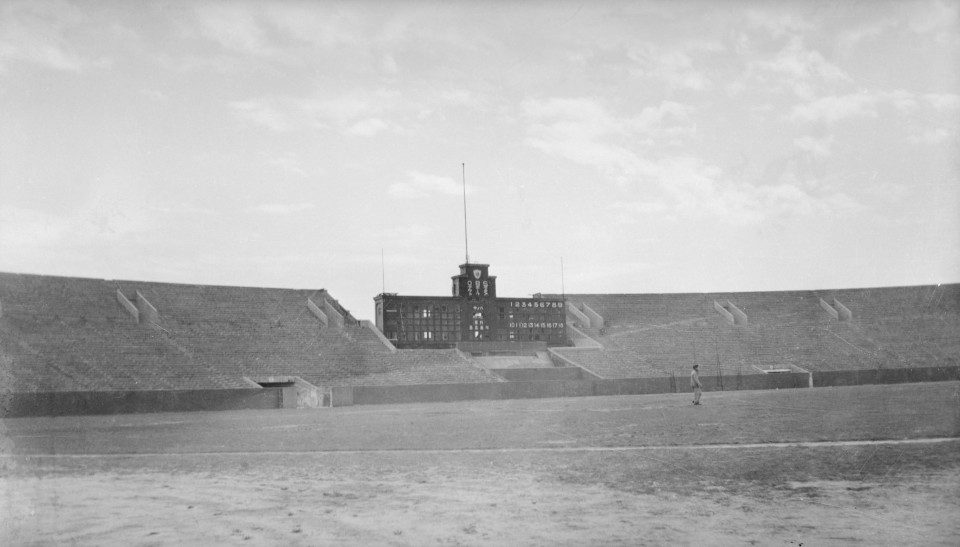
In 1929, the park was changed. Grass was put in the outfield. Big new stands were built along the lines.
The Alps Stands
The stands built in 1929 were very tall. They rose 50 rows high.
People said they looked like the Alps, the big mountains in Europe. So they got the name “Alps Stands.” The name is still used today.
In the high school games, the Alps Stands are where each school’s fans sit. Students, bands and cheer teams fill them up.
The Ivy
The outside walls of Koshien are covered in ivy. It is one of the most famous sights in Japanese baseball.
The ivy was planted in December 1924, the year the park opened. At first, the outside walls were plain concrete. The ivy was a cheap way to make them look nicer.
When the park was redone in the 2000s, the ivy was taken down for a while. The walls were covered in brick. Then the ivy was planted again. It has grown back over the walls.
Babe Ruth at Koshien
In 1934, a team of MLB stars toured Japan. Babe Ruth was on it.
On November 24, 1934, they played a game at Koshien. There is a plaque at the stadium that marks the visit.
That tour helped lead to pro baseball in Japan. You can read about it on our NPB founding page.
The Tigers Move In
In December 1935, the Hanshin railway started a pro team. It was called the Osaka Tigers. Today, it is the Hanshin Tigers.
The Tigers have played at Koshien since 1936. As of the 2025 season, it is the oldest home park in NPB.
On September 25, 1936, a famous game was played there. Eiji Sawamura of the Giants threw a no-hitter against the Tigers. It was the first no-hitter in Japanese pro baseball.
In 1961, the team changed its name to the Hanshin Tigers. On February 14, 1964, the stadium’s name changed too. It became Hanshin Koshien Stadium.
Read more about the team on our Hanshin Tigers history page.
The War Years
World War II was hard on Koshien.
The park had a huge steel roof over the stands. People called it the “iron umbrella.” In 1943, the government needed metal for the war. On August 6, 1943, the roof was taken down for its steel.
High school and pro baseball both stopped during the war. The stands and the grounds around the park were used by the military.
The US Army Takes Over
After the war, the US Army took over the stadium. That was on October 3, 1945.
In 1946, there were no big games at Koshien. The summer tournament had to move to another park.
In 1947, the Army gave back part of the park. The spring high school tournament came back on March 30. The summer one came back on August 13.
The whole park was finally given back on March 31, 1954.
The Lucky Zone
In 1947, Koshien added something new. It was called the “lucky zone.”
The outfield was very big. Home runs were rare. So a fence was put up inside the outfield wall. Balls that went over the inner fence were home runs. That made home runs easier.
It was the first lucky zone in Japan.
The lucky zone stayed for a long time. It was taken out on March 1, 1992.
The Silver Umbrella
On July 5, 1951, a new roof went up over the seats behind home plate. It was not made of iron this time. It was made of a light, strong metal. It shone silver.
People called it the “Ginsan.” That means “silver umbrella.” The name stuck.
The roof has been replaced a few times since. The newest one went up in 2009. It has no posts in the way of the fans.
The Scoreboard
Koshien’s scoreboard sits in center field. It has changed many times.
- 1925: The first scoreboard opened.
- 1934: A second, bigger one was built. People said it looked like a battleship.
- 1958: The scoreboard was changed so that all of it was written by hand.
- 1984: A third scoreboard went up. It marked the park’s 60th year.
- 2019: The scoreboard got one big video screen.
Big Firsts at Koshien
Koshien has hosted many big moments.
- 1936: The first no-hitter in Japanese pro baseball, by Eiji Sawamura.
- 1950: A game of the first Japan Series. You can read about the series on our 1950 league split page.
- 1951: The first game of the first All-Star Series.
- 1956: Lights went up. Night games could be played.
- 1964: The first relief car brought a pitcher in from the bullpen. The first pitcher to ride it was Gene Bacque.
- 1983: The outfield grass was made to stay green all year. It was the first natural grass field in Japan to do that.
- 2021: The final of the girls’ high school tournament was played there. It was the first women’s baseball at Koshien. See our page on women’s baseball in Japan.
Other Teams at Koshien
The Tigers are not the only pro team to use Koshien.
In 1948 and 1949, the Nankai Hawks also used it as their main park. They stopped at the end of 1949.
In April 2011, the Rakuten Eagles hosted the Orix Buffaloes at Koshien for three games. It was the first time since 1950 that a Pacific League team hosted a regular season game there.
Newer Changes
The park keeps getting small updates.
- 2018: The dugouts were rebuilt in the MLB style.
- 2022: The lights were changed to LED. The warning track was made wider.
The 1995 Earthquake
On January 17, 1995, a huge earthquake hit the Kobe area. It is called the Great Hanshin Earthquake.
Koshien was hurt. Cracks showed up in the stands. Part of the stands fell down.
But the base of the park was strong. It was fixed. The spring tournament went on that year.
The Big Makeover
By the 2000s, the old park needed work. In 2004, a plan was made to rebuild it.
The work was done in three stages. Each stage was done in the off-season. That way, games could still be played.
- 2008: The infield stands were rebuilt.
- 2009: The Alps Stands, the outfield stands, the lights and the roof were rebuilt.
- 2010: The last work was done on March 12. A museum about Koshien opened too.
The plan kept the things fans loved. The ivy stayed. The dirt infield stayed. The grass outfield stayed. And there is still no roof over the field.
The seats got a bit wider. That meant there were fewer of them. After the work, the park held 47,808 people.
How Many People It Holds
The number of seats at Koshien has changed many times.
- 1924: About 55,000.
- Up to 1986: The park said it held 58,000.
- 2002: About 53,000, after some seats got wider.
- 2009 to 2011: 47,808.
- 2016: 47,508.
- 2020: For pro games only, 43,508.
Different sources give different numbers. That is because the park keeps changing its seats. As of the 2025 season, it holds about 47,000 for high school games and fewer for Tigers games.
The Dirt
Koshien has an all-dirt infield. There is no grass on it at all.
The dirt is a special mix. It uses black soil from many parts of Japan. It is mixed with white sand from Kyoto.
The black soil helps fans see the white ball as it moves across the infield.
The Hamakaze Wind
There is a famous wind at Koshien. It is called the “hamakaze.” That means “sea breeze.”
It blows in from the sea, from behind right field. It blows toward left field. It is strongest on sunny summer days.
The wind makes it hard for left-handed hitters to hit home runs to right field. The ball gets pushed back.
But some lefties learned to use it. Masayuki Kakefu and Randy Bass hit many home runs the other way, to left. The wind helped carry those balls. Read more about Bass on our page on Americans in NPB.
High School Baseball Comes First
At Koshien, the high school tournaments come first.
Every summer, the Tigers have to leave home for weeks. They go on a long road trip. Their home park is used for the summer tournament.
If a high school game has to be moved, the Tigers’ games get moved too. The high school games win.
Players who reach Koshien in high school never forget it. Many of the stars of Japanese baseball first became famous there. Sadaharu Oh won the spring tournament there in 1957. Yu Darvish threw a no-hitter there in 2004. See our pages on Sadaharu Oh and Yu Darvish.
Not Just Baseball
Koshien hosts more than baseball.
It hosts the Koshien Bowl. That is the college football title game in Japan. It is American-style football.
Big music concerts have been held there too. Local schools in Nishinomiya also hold a sports day there each fall.
100 Years Old
On August 1, 2024, Koshien turned 100. That day, the Tigers played the Giants there. There were events and a big party for three days.
That year, the park was also named a civil engineering heritage site in Japan.
How to Get There
Koshien is easy to reach by train. It is a two-minute walk from Koshien Station on the Hanshin Main Line.
There is no parking lot for fans. So most people take the train.
Timeline
- 1924: Work begins on March 11. The park opens on August 1. Ivy is planted in December.
- 1929: Grass goes in the outfield. The Alps Stands are built.
- 1934: Babe Ruth plays there on November 24.
- 1936: The Tigers start playing there. Sawamura throws a no-hitter on September 25.
- 1943: The iron roof is taken for the war.
- 1945: The US Army takes over the park on October 3.
- 1947: Part of the park is given back. The lucky zone is added.
- 1951: The silver roof goes up. The first All-Star game is played.
- 1954: The whole park is given back.
- 1956: Lights go up for night games.
- 1964: The name becomes Hanshin Koshien Stadium.
- 1992: The lucky zone is taken out.
- 1995: The earthquake damages the stands.
- 2008 to 2010: The big makeover.
- 2021: The first girls’ high school final is held there.
- 2024: The park turns 100.
Key Terms
- Koshien: The stadium. Also the name people use for the high school tournaments.
- Alps Stands: The tall stands along the lines. School fans sit there.
- Ginsan: The silver roof over the seats behind home plate.
- Lucky zone: An inner fence that made home runs easier. It was used from 1947 to 1992.
- Hamakaze: The sea breeze that blows from right field to left.
- Ivy: The plants that cover the outside walls.
More terms are in our glossary.
Common Questions
How old is Koshien Stadium? It opened on August 1, 1924. It turned 100 in 2024.
How many people does Koshien hold? About 47,000. The number is lower for Tigers games. It has changed many times over the years.
Is Koshien the oldest ballpark in Japan? It is the oldest home park of an NPB team. But Meiji Jingu Stadium in Tokyo opened in 1926 as a park built just for baseball. Koshien was first built for other sports too.
Why do the Tigers go on the road in August? Because the summer high school tournament uses Koshien. It comes first.
Does Koshien have a roof? Only over the seats behind home plate. The field is open.
Does Koshien have grass in the infield? No. The infield is all dirt. The outfield is grass.
The Bottom Line
Koshien Stadium opened in 1924. It was built for high school baseball. It still hosts the big high school tournaments every spring and summer.
It is also home to the Hanshin Tigers. They have played there since 1936.
The park lived through a war, years under the US Army, and a big earthquake. It was rebuilt but kept its ivy, its dirt and its open sky.
As of the 2025 season, it is the oldest home park in NPB. For many fans, it is the heart of Japanese baseball.
For more ballparks, see our stadiums page. For the high school side of the story, see our Koshien guide.
Sources
- Wikipedia, “Koshien Stadium.” https://en.wikipedia.org/wiki/Koshien_Stadium
- Wikipedia (Japanese), “阪神甲子園球場.” https://ja.wikipedia.org/wiki/阪神甲子園球場
- Wikipedia, “Hanshin Tigers.” https://en.wikipedia.org/wiki/Hanshin_Tigers
- Hanshin Koshien Stadium, official site (English). https://www.hanshin.co.jp/koshien/english/