Teams › Hanshin Tigers: Complete Team History
The Hanshin Tigers are the second-oldest team in Japan. They play in the most famous ballpark in the country. And they may have the loudest fans in all of baseball.
They have not won as often as some teams. For long stretches, they lost a lot. But their fans never left. That is a big part of their story.
This page covers it all. We start in 1935. We go through the great years, the lean years, the curse, and the big wins. At the end, there is a timeline.
Here’s the thing. The Tigers are not just a team in their part of Japan. They are a way of life.
New to Japanese baseball? Start with how NPB works. It explains the two leagues and the Japan Series. You can find all twelve clubs on our teams page.
Quick Facts
- League: Central League.
- Area: The Osaka and Kobe area, in western Japan. The park is in Nishinomiya, in Hyogo.
- Founded: December 10, 1935.
- First name: Osaka Tigers.
- Owner: Hanshin Electric Railway. It is a train company.
- Home park: Koshien Stadium, since 1936.
- Team song: “Rokko Oroshi.”
- Japan Series titles: 2 (1985 and 2023).
- League titles: 11 (through 2025). That counts 4 from the old single league and 7 in the Central League.
- Mascots: To-Lucky and his tiger family.
How the Team Began
In 1934, the Yomiuri newspaper started a pro team in Tokyo. That team became the Giants. The newspaper wanted other companies to start teams too. That way, there could be a league.
The Hanshin train company said yes. It ran trains between Osaka and Kobe. It also owned a big ballpark called Koshien. A team would bring riders to its trains and fans to its park.
So on December 10, 1935, the club was born. It was called the Osaka Tigers.
In 1936, Japan’s first pro league began. The Tigers were one of the first teams. Only the Giants are older.
Names Over the Years
The Tigers have had only a few names.
- 1936 to 1940: Osaka Tigers.
- 1940 to 1944: Hanshin. During the war, the government did not want English names. So the team dropped “Tigers” and used the company name.
- 1946 to 1960: Osaka Tigers again.
- 1961 on: Hanshin Tigers.
The owner has always been the same train company. In 2006, Hanshin joined with another train company called Hankyu. Hankyu used to own a pro team too. That team is now the Orix Buffaloes. You can read about it on our Orix Buffaloes history page.
Home Park: Koshien
The Tigers have one home and only one. It is Koshien Stadium.
Koshien opened in 1924. It was built for high school baseball. It still hosts two big high school tournaments each year. The Tigers have played there since 1936.
The park has ivy on the walls. It has an all-dirt infield. It is open to the sky.
There is one odd thing about it. Every August, the high school tournament takes over. So the Tigers have to go on a long road trip. Fans call it “the road of death,” because the team often slumps.
To learn more, read our guide Koshien explained.
The Early Years: 1936 to 1949
The Tigers were good right from the start. They met the Giants in a playoff in the fall of 1936. The Giants won. That was the first of many big games between the two teams.
The Tigers won the fall title in 1937 and the spring title in 1938.
An early star was Masaru Kageura. He was a great hitter and a good pitcher. He won the batting title. He died in the war in 1945.
During the war, many players went into the army. The Tigers still won the title in 1944.
After the war, the Tigers had a famous lineup. People called it the “Dynamite lineup.” It hit the ball hard and often. The team won the title in 1947.
The heart of that team was Fumio Fujimura. He was the first big home run hitter in Japan. He was so loved that fans called him “Mr. Tigers.” His No. 10 is retired.
The League Splits: The 1950s
In 1950, the league split into two leagues. The Tigers joined the Central League.
The split hurt the team. Several stars left to join new clubs in the other league. One of them was the slugger Kaoru Bettou.
The Tigers did not win a pennant in the 1950s. But they had a strong infield. Shortstop Yoshio Yoshida was small and quick. He was one of the best fielders of his time. His No. 23 is retired.
Murayama and the Emperor’s Game
In 1959, the team got a new star pitcher. His name was Minoru Murayama.
That same year, the Emperor came to watch a game. It was the Tigers against the Giants at Korakuen, on June 25, 1959. In the ninth inning, Nagashima of the Giants hit a home run off Murayama. It ended the game.
Murayama said for the rest of his life that the ball was foul. He never let it go. He made beating Nagashima his life’s goal.
Murayama won the Sawamura Award three times. His No. 11 is retired.
Pennants in the 1960s
The Tigers won the pennant in 1962. They lost the Japan Series to the Toei Flyers. That team is now the Nippon-Ham Fighters.
They won again in 1964. This time they lost the Japan Series to the Nankai Hawks in seven games. Both teams were from the Osaka area. It was a local series. You can read the Hawks side on our SoftBank Hawks history page.
A tall pitcher from Hawaii named Gene Bacque starred on the 1964 team. He won 29 games. He was the first foreign player to win the Sawamura Award.
Enatsu and Kakefu: The 1960s and 1970s
In 1967, a lefty pitcher named Yutaka Enatsu joined the Tigers. He threw hard and he threw a lot.
In 1968, he struck out 401 batters. That is still the most in one season in Japan. In the 1971 All-Star Game, he struck out nine batters in a row.
These were the years of the Giants’ V9 run. The Tigers came close to the pennant a few times, but the Giants kept winning.
In 1974, a third baseman named Masayuki Kakefu joined the team. He became the team’s best hitter. In 1979, he hit 48 home runs. Like Fujimura, fans called him “Mr. Tigers.”
1985: The Big Year
1985 is the most famous year in team history.
On April 17, the Tigers played the Giants at Koshien. In one inning, three Tigers hit home runs in a row. First Randy Bass. Then Kakefu. Then Akinobu Okada. All three balls went to center field. Fans call it the “back screen three in a row.”
Randy Bass was an American first baseman. That year, he won the Triple Crown. That means he led the league in batting average, home runs, and RBIs. He did it again in 1986. In 1986, he hit .389.
The team hit 219 home runs that year. It was a league record.
The year also had sad news. On August 12, a Japan Airlines plane crashed. The team’s president, Hajime Nakano, was on board. He was killed.
The Tigers won the pennant. Then they beat the Seibu Lions in the Japan Series, four games to two. It was their first Japan Series title. The manager was Yoshio Yoshida, the old shortstop.
The Curse of the Colonel
After the pennant, fans partied in Osaka. Many jumped into the Dotonbori River. That is a canal in the middle of the city.
Some fans took turns jumping in for each player. When it was Bass’s turn, they could not find a fan who looked like him. So they grabbed a statue of Colonel Sanders from a KFC. Like Bass, he had a beard and was not Japanese. They threw the statue into the river.
Then the Tigers stopped winning. Fans joked that the Colonel had cursed them.
Parts of the statue were found in the river in 2009. By then, the Tigers had already won two more pennants.
The Dark Years: 1987 to 2001
The years after 1985 were hard. From 1987 to 2001, the Tigers came in last ten times in fifteen years. In Japan, people call this the “dark age.”
Even famous manager Katsuya Nomura could not turn it around. He ran the team from 1999 to 2001. The team finished last all three years.
But the fans kept coming. Koshien stayed full. That says a lot about Tigers fans.
Hoshino, Okada, and the 2000s
In 2002, Senichi Hoshino became the manager. He had been a star pitcher and manager for the Chunichi Dragons.
In 2003, the Tigers won the pennant. It was their first in 18 years. A lefty named Kei Igawa won 20 games and the Sawamura Award. See the 2003 title holders page. The Tigers lost the Japan Series to the Daiei Hawks in seven games. Every game was won by the home team.
In 2004, Okada became the manager. In 2005, the Tigers won the pennant again. Their bullpen was famous. Three relievers, Jeff Williams, Kyuji Fujikawa, and Tomoyuki Kubota, were called “JFK.” Makoto Imaoka drove in 147 runs. But in the Japan Series, the Chiba Lotte Marines swept them in four games.
Speedy Norihiro Akahoshi led the league in steals five years in a row, from 2001 to 2005. See the stolen bases title holders page.
Tomoaki Kanemoto came over from the Carp in 2003. He set a world record by playing every inning of 1,492 games in a row.
Matt Murton got 214 hits in 2010. That was a new record for one season in Japan at the time.
In 2014, the Tigers made the Japan Series after finishing second. They lost to the SoftBank Hawks.
2023: “Are”
Okada came back as manager in 2023. He did not like to say the word “win.” He did not want to jinx it. So he called it “are.” That means “that thing.” The whole country picked up the word. It became the top new word of the year in Japan.
The Tigers won the pennant. Then they faced the Orix Buffaloes in the Japan Series. Both teams were from the same area, so it was a local series again. The Tigers won in seven games. It was their first Japan Series title in 38 years.
Young pitchers led the way. Shoki Murakami had the league’s best ERA. See the 2023 title holders page.
The Tigers won the pennant again in 2025. Slugger Teruaki Sato led the league in home runs and RBIs. See the 2025 title holders page. They lost the Japan Series to the SoftBank Hawks.
As of the 2025 season, the Tigers have won 2 Japan Series and 11 league titles.
Championships
Japan Series titles (2): 1985 and 2023.
Japan Series losses (6):
- 1960s: 1962, 1964.
- 2000s: 2003, 2005.
- 2010s: 2014.
- 2020s: 2025.
Old single-league titles (4): fall 1937, spring 1938, 1944, 1947.
Central League pennants (7):
- 1960s: 1962, 1964.
- 1980s: 1985.
- 2000s: 2003, 2005.
- 2020s: 2023, 2025.
The 2014 team reached the Japan Series through the playoffs. It did not win the pennant that year.
Legendary Players
- Masaru Kageura. Early star hitter. Died in the war.
- Fumio Fujimura. The first “Mr. Tigers.” A slugger and later the manager.
- Yoshio Yoshida. Shortstop. Manager of the 1985 champs.
- Minoru Murayama. Pitcher. Rival of Nagashima.
- Gene Bacque. Pitcher. First foreign Sawamura Award winner.
- Yutaka Enatsu. Pitcher. 401 strikeouts in 1968.
- Masayuki Kakefu. Third baseman. “Mr. Tigers.”
- Randy Bass. First baseman. Two Triple Crowns.
- Akinobu Okada. Second baseman. Later won two pennants as manager.
- Tomoaki Kanemoto. Outfielder. Iron man record.
- Kyuji Fujikawa. Closer. Known for his rising fastball.
- Kei Igawa. Pitcher. 20 wins in 2003.
The team has retired three numbers: Fujimura’s No. 10, Murayama’s No. 11, and Yoshida’s No. 23.
Great Managers
- Yoshio Yoshida. Won the 1985 Japan Series.
- Senichi Hoshino. Won the 2003 pennant.
- Akinobu Okada. Won pennants in 2005 and 2023 and the 2023 Japan Series.
Famous Moments
The 1936 playoff. The first big game against the Giants.
The Emperor’s game. The 1959 walk-off homer Murayama said was foul.
401 strikeouts. Enatsu’s 1968 season.
Back screen three in a row. April 17, 1985.
The Colonel goes in the river. The night of the 1985 title.
“Are.” The word that took over Japan in 2023.
Rivalries
The Yomiuri Giants. This is the biggest rivalry in Japan. Osaka against Tokyo. The common people’s team against the rich team. It is called “the traditional game.” Read the other side on our Yomiuri Giants history page.
The Orix Buffaloes. A local rival from the same area. Their games are called the “Kansai Classic.” Kansai is the name of the region.
The Hiroshima Carp. A Central League rival with very loud fans of its own. See our Hiroshima Carp history page.
Culture, Mascot and Cheering
The song. The team song is “Rokko Oroshi.” The name means “the wind off Mount Rokko.” Mount Rokko is a mountain near Kobe. The song was written in 1936. The music is by Yuji Koseki. It is the oldest team song still used in Japanese pro ball. Fans sing it after every win. Many fans in the region know every word.
The balloons. In the seventh inning, fans blow up long balloons. They sing the song. Then they let the balloons go. Hundreds fly up at once and whistle as they go. Other teams do this too, but the Tigers’ version is the most famous.
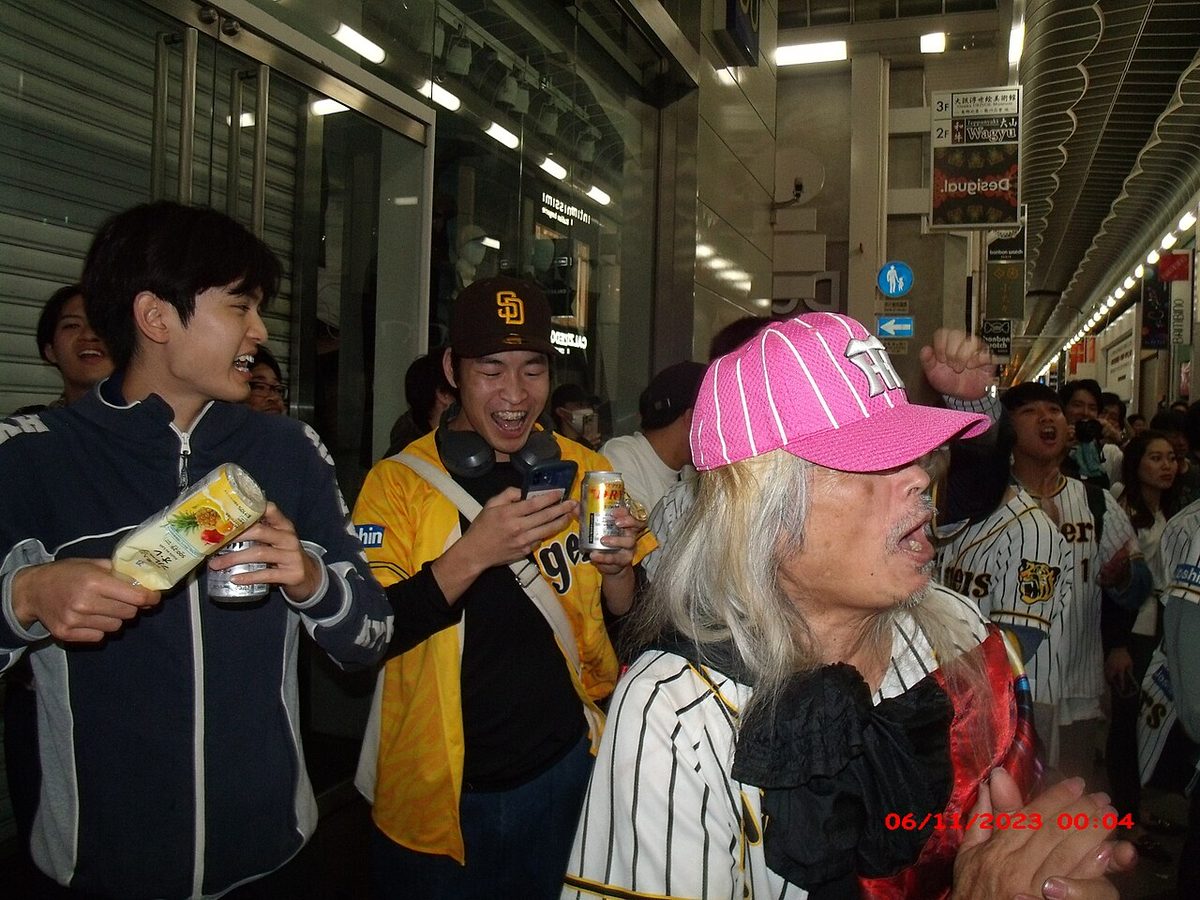
The colors. Yellow and black, like a tiger. Fans dress head to toe in stripes.
The mascots. The main mascot is a tiger named To-Lucky. His girlfriend is Lucky. There is also Keeta, a younger tiger, and a cub called Co-Lucky. To-Lucky’s number is 1985, for the title year.
The cheering section. The outfield stands are loud from the first pitch to the last. Trumpets play. Fans sing a song for each player.
The river. When the Tigers win big, some fans still jump into the Dotonbori River. The police try to stop them. It does not always work.
Timeline
- 1935: The club is founded on December 10.
- 1936: First season. Koshien becomes home. First playoff with the Giants.
- 1937: Fall title.
- 1938: Spring title.
- 1940: Name changes to Hanshin during the war.
- 1944: League title.
- 1946: Back to Osaka Tigers.
- 1947: League title with the Dynamite lineup.
- 1950: Joins the Central League.
- 1959: The Emperor’s game.
- 1961: Name becomes Hanshin Tigers.
- 1962: Pennant.
- 1964: Pennant.
- 1968: Enatsu strikes out 401.
- 1985: Back screen three in a row. First Japan Series title. The Colonel goes in the river.
- 1986: Bass wins a second Triple Crown.
- 1987 to 2001: The dark age.
- 2003: Pennant under Hoshino.
- 2005: Pennant under Okada.
- 2009: Parts of the Colonel are found.
- 2014: Japan Series loss after a playoff run.
- 2023: “Are.” Second Japan Series title.
- 2025: Pennant.
- As of 2025: 2 Japan Series titles and 11 league titles.
Key Terms
Koshien. The Tigers’ home park, and the name of Japan’s big high school tournaments.
Rokko Oroshi. The team song.
Kansai. The region around Osaka, Kobe, and Kyoto.
Dark age. The losing years from 1987 to 2001.
Are. “That thing.” Okada’s word for winning the pennant.
Triple Crown. Leading the league in batting average, home runs, and RBIs in the same year.
Common Questions
How many Japan Series have the Tigers won? Two, as of the 2025 season. They won in 1985 and 2023.
Is the Curse of the Colonel real? It is a fun story. The Tigers have won pennants since, and a Japan Series title in 2023.
Why do the Tigers go on the road every August? Because the high school tournament uses Koshien.
Who was Randy Bass? An American slugger who won the Triple Crown in 1985 and 1986.
Why are Tigers fans so famous? They are loud, they sing, and they never left, even in the dark age.
The Bottom Line
The Tigers have won less than their old rivals in Tokyo. But no team has fans who care more. They filled Koshien when the team won. They filled it when the team finished last.
There is a lesson in that. Love for a team is not about the trophies. It is about showing up, again and again.
See all the clubs on our teams page. For year-by-year leaders, see the title holders hub.
Sources
- Wikipedia, “Hanshin Tigers.” https://en.wikipedia.org/wiki/Hanshin_Tigers
- Wikipedia (Japanese), “阪神タイガース.” https://ja.wikipedia.org/wiki/阪神タイガース
- Wikipedia, “Curse of the Colonel.” https://en.wikipedia.org/wiki/Curse_of_the_Colonel
- Wikipedia, “Japan Series.” https://en.wikipedia.org/wiki/Japan_Series
- Wikipedia, “Japanese Baseball League.” https://en.wikipedia.org/wiki/Japanese_Baseball_League
- Wikipedia, “Central League.” https://en.wikipedia.org/wiki/Central_League
- Hanshin Tigers official site. https://hanshintigers.jp/
- ESPN, coverage of Randy Bass and the Tigers. https://www.espn.com/
- Japan Times, baseball section. https://www.japantimes.co.jp/sports/baseball/