Teams › Yokohama DeNA BayStars: Complete Team History
The Yokohama DeNA BayStars are the team of Yokohama, the big port city just south of Tokyo.
They started as a fishing company’s team. They were called the Whales. They have moved four times. They have changed their name more times than that.
They have also won the Japan Series three times. Each title came as a big surprise. Two of them came after a long, long wait.
This page tells the whole story. We start in 1949 in a small fishing town. We go through the Whales, the “Machine Gun” lineup, the dark years, and the comeback. At the end, there is a timeline.
Here’s the thing. The BayStars are the team that never gives up hope. Their fans have needed a lot of it.
If you are new to how the leagues work, read how NPB works first. All twelve clubs are on our teams page.
Quick Facts
- League: Central League.
- City: Yokohama, in Kanagawa.
- Founded: 1949, as the Taiyo Whales.
- First home town: Shimonoseki, in Yamaguchi.
- Owner: DeNA, a tech company, since 2012.
- Home parks: Shimonoseki (1950 to 1952). Osaka (1953 to 1954). Kawasaki Stadium (1955 to 1977). Yokohama Stadium (1978 on).
- Japan Series titles: 3 (1960, 1998, 2024).
- League titles: 2 Central League pennants (1960 and 1998).
- Mascot: DB.Starman.
- Team song: “Atsuki Hoshitachi yo.”
How the Team Began
The team’s roots go back to a fishing company. It was called Taiyo Gyogyo. It was based in Shimonoseki, a port town at the far west end of Japan’s main island. “Taiyo” means “ocean.” “Gyogyo” means “fishing.”
The company had a strong amateur team for many years. In 1949, pro baseball in Japan grew into two leagues. The company decided to go pro.
The new team was called the Taiyo Whales. A whale fit a fishing company. The team joined the new Central League in 1950.
Names, Owners and Moves
This team has moved more than most. Here is the full list.
- 1950 to 1952: Taiyo Whales, in Shimonoseki.
- 1953: Taiyo Shochiku Robins. The Whales merged with a team called the Shochiku Robins. The team moved to Osaka.
- 1954: Yo-Sho Robins. Still in Osaka.
- 1955 to 1977: Taiyo Whales again. The team moved to Kawasaki, near Tokyo.
- 1978 to 1992: Yokohama Taiyo Whales. The team moved to Yokohama.
- 1993 to 2011: Yokohama BayStars. The fishing company dropped its name from the team.
- 2012 on: Yokohama DeNA BayStars.
Owners changed too. The fishing company owned the team for about fifty years. A TV company called TBS took control in 2002. The tech company DeNA bought the team after the 2011 season.
The Shochiku Robins were the first Central League champions, back in 1950. When they merged into the Whales, their history came along. So the BayStars count the Robins as part of their family tree.
Home Parks
Shimonoseki. The Whales started in their company’s home town. It was far from the big cities.
Osaka. After the merger, the team spent two years in Osaka.
Kawasaki Stadium. In 1955, the Whales moved to Kawasaki. It is a city between Tokyo and Yokohama. The park was small and plain. Crowds were often thin.
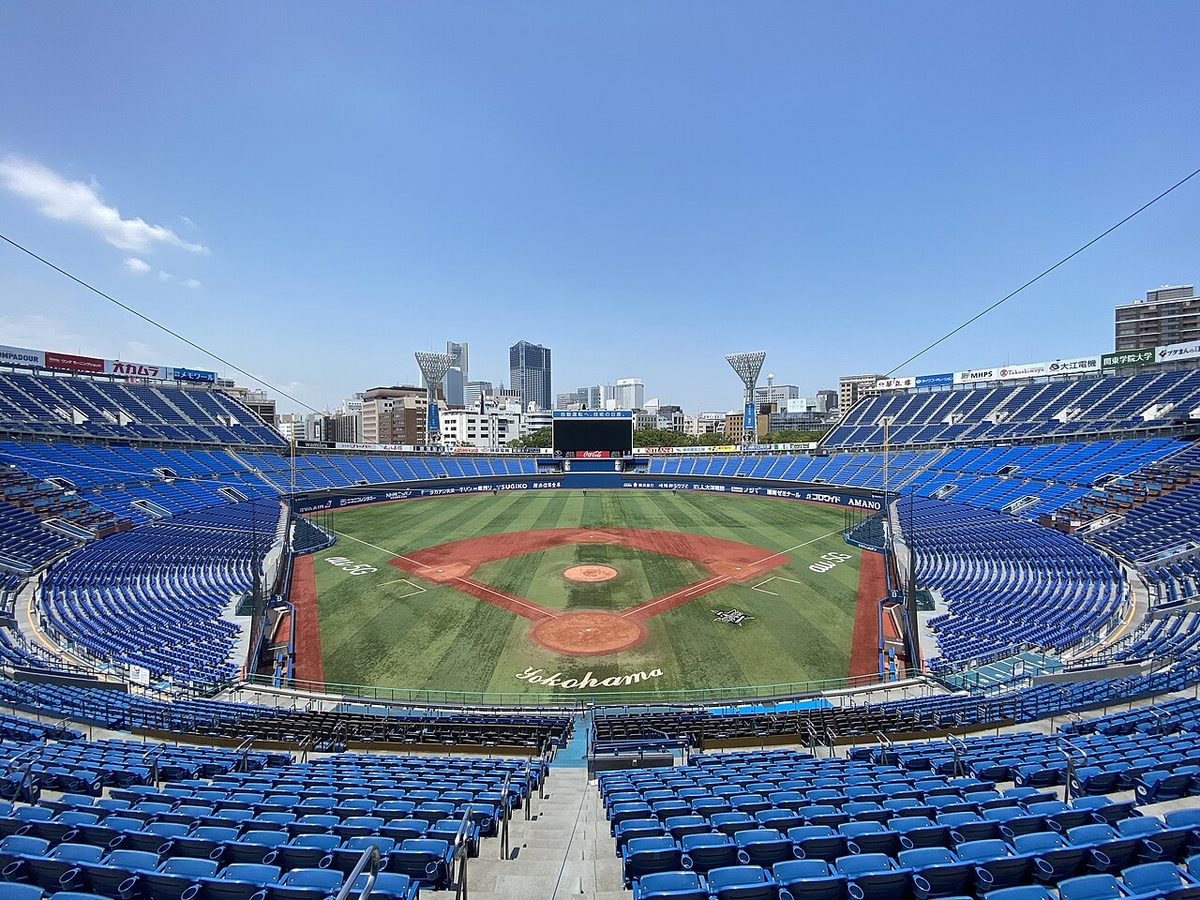
Yokohama Stadium. In 1978, the team moved to a brand-new park in Yokohama. It sits in a park in the middle of the city, close to the harbor. It has been home ever since.
Yokohama Stadium also has history of its own. An older park on the same spot hosted Babe Ruth and his American stars in 1934.
1960: Last to First
The Whales of the 1950s were bad. They finished last many times. In 1959, they came in last again.
Then they hired Osamu Mihara as manager. Mihara was a smart, bold baseball man. He had already won three Japan Series with the Nishitetsu Lions. See our Seibu Lions history page.
People called his style “Mihara magic.” He made surprise moves. He used players in new ways. He used his pitchers well.
In 1960, the Whales went from last place to first. They won the pennant.
In the Japan Series, they faced the Daimai Orions. The Orions had a powerful lineup. Most people thought the Orions would win.
The Whales swept them in four games. Every game was won by just one run. It is still one of the biggest upsets in Japan Series history.
The Orions are now the Chiba Lotte Marines. You can read their side on our Chiba Lotte Marines history page.
The Long Wait: 1961 to 1997
After 1960, the Whales did not win another pennant for 38 years.
They had some great players in that time.
Masaji Hiramatsu was an ace in the 1960s and 1970s. He threw a pitch called the “razor shoot.” It moved in hard on right-handed hitters. He won 201 games.
Clete Boyer played for the Whales in the 1970s. He had been a top third baseman for the New York Yankees. He later coached for the team.
In the 1980s, the team had three fast runners at the top of the lineup. They were Yutaka Takagi, Hirokazu Kato, and Kaname Yashiki. People called them the “Super Car Trio.” They stole a lot of bases. But the team did not win much.
In 1993, the team became the Yokohama BayStars. New name. New colors. New hope.
1998: The Machine Gun Offense
In 1998, the BayStars finally broke through.
The manager was Hiroshi Gondo. He let his players play. He did not use a lot of bunts.
The lineup was famous. It did not wait for home runs. It hit single after single. When it got going, the runs came fast. People called it the “Machine Gun Offense.”
The leaders included:
- Takuro Ishii, a speedy leadoff hitter and third baseman.
- Bobby Rose, an American second baseman who hit for average and power.
- Takanori Suzuki, a line-drive hitter in the middle of the order.
- Hiroshi Komada, a veteran first baseman.
- Motonobu Tanishige, a tough catcher.
The pitching had one big star. His name was Kazuhiro Sasaki. He was the closer. He threw a nasty forkball. Fans called him “Daimajin,” after a giant stone god from an old movie. In 1998, he saved 45 games.
On October 8, 1998, the BayStars won the pennant. It was their first in 38 years.
In the Japan Series, they faced the Seibu Lions. The BayStars won in six games. The city held a huge parade.
Sasaki later pitched for the Seattle Mariners. He won the American League Rookie of the Year in 2000.
The Dark Years: 2000s
After 1998, the team slid down. Bobby Rose left after 2000. Sasaki left for Seattle.
The 2000s were hard. The BayStars finished last many times. Crowds got small.
There were still good players.
- Daisuke Miura was a pitcher who spent his whole career in Yokohama, from 1992 to 2016. Fans called him “Hama no Bancho.” That means “the boss of Yokohama.” He wore a big pompadour hairdo. He led the league in ERA in 2005.
- Tyrone Woods led the league in home runs in 2003 and 2004. See the 2003 title holders page.
- Shuichi Murata led the league in home runs in 2007 and 2008.
- Seiichi Uchikawa hit .378 in 2008. That was one of the highest marks ever for a right-handed hitter in Japan. See the batting average title holders page.
The DeNA Era
After the 2011 season, the tech company DeNA bought the team. It made big changes.
DeNA treated games like big events. It added better food, fun nights, and special shirts. It made the park feel like a party. It also bought the company that runs Yokohama Stadium. Then it made the park bigger.
Crowds came back. Young fans and families filled the seats. Soon, tickets were hard to get.
On the field, the team got better too. Yoshitomo Tsutsugo became a slugger. In 2016, he led the league in home runs and RBIs. See the 2016 title holders page.
Alex Ramirez became the manager in 2016. He had been a star hitter for the Swallows and the Giants. In 2017, the BayStars finished third. They won two playoff rounds and made the Japan Series. They lost to the SoftBank Hawks in six games.
Other stars of the DeNA years included:
- Neftali Soto, who led the league in homers in 2018 and 2019.
- Toshiro Miyazaki, who won two batting titles.
- Shota Imanaga, a lefty who led the league in strikeouts in 2023. See the strikeouts title holders page.
- Yasuaki Yamasaki, a closer with a big fan following.
2024: Third Place to the Top
In 2024, the BayStars finished third again. Daisuke Miura, the old pitcher, was the manager.
They won two playoff rounds. Then they faced the SoftBank Hawks in the Japan Series. The Hawks had won 91 games that year. They were big favorites.
The Hawks won the first two games. Then the BayStars won four in a row. They took the Japan Series for the first time in 26 years.
It was the team’s third Japan Series title. And for the second time, it came as a huge upset. See the 2024 title holders page for that year’s stat leaders. You can read the Hawks side on our SoftBank Hawks history page.
As of the 2025 season, the team has won 3 Japan Series and 2 Central League pennants.
Eras at a Glance
The Whales. 1950 to 1992. A fishing team. One big title in 1960.
The early BayStars. 1993 to 2001. New name. The Machine Gun. The 1998 title.
The dark years. The 2000s. Lots of losing. Small crowds.
The DeNA years. 2012 on. Big crowds. A party in the park. Two Japan Series runs from third place.
How to Follow the BayStars
Here are some tips if you are new to this team.
Go to Yokohama Stadium. It is close to the harbor and Chinatown. Walk around before the game.
Buy a ticket early. Games sell out often. Plan ahead.
Try the food. The park has its own beer and lots of snacks. It is part of the fun.
Wear blue. Many games give fans a free shirt. Some nights the whole park is one color.
Pick a player. Follow one young player for a few years. That is the best way to care.
Here’s the thing. The BayStars do not win every year. But a night at their park is a night out, win or lose.
Championships
Japan Series titles (3): 1960, 1998, 2024.
Japan Series losses (1): 2017.
Central League pennants (2): 1960 and 1998.
The 2017 and 2024 teams reached the Japan Series after finishing third. Neither won the pennant.
Legendary Players
- Masaji Hiramatsu. Ace. The razor shoot. 201 wins.
- Akihito Kondo. Infielder. Star of the 1960 Japan Series.
- Clete Boyer. Former Yankee who played and coached for the Whales.
- The Super Car Trio. Takagi, Kato, and Yashiki. Speed at the top of the lineup.
- Takuro Ishii. Leadoff man. More than 2,000 hits.
- Bobby Rose. Second baseman. Star of 1998.
- Kazuhiro Sasaki. “Daimajin.” The closer.
- Motonobu Tanishige. Catcher. Later set Japan’s record for games played.
- Daisuke Miura. “Hama no Bancho.” One team for 25 years.
- Seiichi Uchikawa. Hit .378 in 2008.
- Yoshitomo Tsutsugo. Slugger. Later played in MLB.
The team has no retired numbers.
Great Managers
- Osamu Mihara. Last to first in 1960.
- Hiroshi Gondo. The 1998 champs.
- Alex Ramirez. Led the 2017 team to the Japan Series.
- Daisuke Miura. Won the 2024 Japan Series.
Famous Moments
The one-run sweep. Four straight one-run wins in the 1960 Japan Series.
The move to Yokohama. A new home in 1978.
The Machine Gun. The 1998 lineup.
Daimajin. Sasaki slamming the door in 1998.
The comeback. Down two games, then four straight wins in 2024.
Rivalries
The Yomiuri Giants. Yokohama is right next to Tokyo. Games against the Giants draw huge crowds. See our Yomiuri Giants history page.
The Tokyo Yakult Swallows. Another nearby rival. The two teams have often fought to stay out of last place. See our Yakult Swallows history page.
The SoftBank Hawks. The 2017 loss and the 2024 win make this a Japan Series rivalry.
Culture, Mascot and Cheering
The mascot. The main mascot is DB.Starman. He is a hamster. The name is a pun. “Hama” is a nickname for Yokohama. “Hamster” sounds like “Hama-star.” Before him, a mascot family called the Hossy family cheered for the team from 1993 to 2012.
The song. The team song is “Atsuki Hoshitachi yo.” It means “Hot Stars.” Fans sing it at big moments.
Bubbles, not balloons. For years, Yokohama Stadium did not allow balloons. So fans blew soap bubbles instead. Later the park allowed a special kind of balloon. The bubbles are still a fun part of the show.
The cheering section. The trumpets in Yokohama often play in two parts, like harmony. That is rare in Japan. Each player has his own song. Before the game, the band plays each starter’s song after his name is called.
The colors. Blue and white, like the sea and the stars.
Big nights. The DeNA years brought theme nights and special jerseys that fans wear to the park. Some summer games give every fan a shirt to wear.
Timeline
- 1949: The Taiyo Whales are formed.
- 1950: First season in the Central League, based in Shimonoseki.
- 1953: Merge with the Shochiku Robins. Move to Osaka.
- 1955: Back to the Whales name. Move to Kawasaki.
- 1959: Last place.
- 1960: First place. Japan Series sweep.
- 1978: Move to Yokohama Stadium. Name becomes Yokohama Taiyo Whales.
- 1985: The Super Car Trio.
- 1993: Name becomes Yokohama BayStars.
- 1998: The Machine Gun Offense. Second Japan Series title.
- 2002: TBS takes control.
- 2012: DeNA takes over. Name becomes Yokohama DeNA BayStars.
- 2016: Tsutsugo leads the league in homers.
- 2017: Japan Series from third place.
- 2024: Third Japan Series title, from third place.
- As of 2025: 3 Japan Series titles and 2 pennants.
Key Terms
Taiyo Gyogyo. The fishing company that started the team.
Whales. The team’s name for its first decades.
Machine Gun Offense. The 1998 lineup that hit single after single.
Daimajin. Kazuhiro Sasaki’s nickname.
Hama. A short name for Yokohama.
Climax Series. The playoff that lets second- and third-place teams reach the Japan Series.
Common Questions
Why were they called the Whales? The first owner was a fishing company.
How many Japan Series have they won? Three, as of the 2025 season. In 1960, 1998, and 2024.
Can a third-place team win the Japan Series? Yes. The BayStars did it in 2024.
Where do the BayStars play? At Yokohama Stadium, since 1978.
Who is DB.Starman? The team’s hamster mascot.
The Bottom Line
The BayStars started as a fishing team in a small port town. They moved again and again. They waited 38 years between pennants. Then a new owner turned the park into a party, and the wins came back.
There is a lesson in that. A team can change almost everything. Its name. Its city. Its owner. What lasts is the fans who keep showing up.
See all the clubs on our teams page. For stat leaders by year, see the title holders hub.
Sources
- Wikipedia, “Yokohama DeNA BayStars.” https://en.wikipedia.org/wiki/Yokohama_DeNA_BayStars
- Wikipedia (Japanese), “横浜DeNAベイスターズ.” https://ja.wikipedia.org/wiki/横浜DeNAベイスターズ
- Wikipedia, “Japan Series.” https://en.wikipedia.org/wiki/Japan_Series
- Wikipedia, “Central League.” https://en.wikipedia.org/wiki/Central_League
- Wikipedia, “Yokohama Stadium.” https://en.wikipedia.org/wiki/Yokohama_Stadium
- Yokohama DeNA BayStars official site. https://www.baystars.co.jp/
- MLB.com, coverage of Kazuhiro Sasaki, Shota Imanaga and Yoshitomo Tsutsugo. https://www.mlb.com/
- Japan Times, baseball section. https://www.japantimes.co.jp/sports/baseball/