Guides › The NPB Draft Explained: How Japan Picks Its New Players
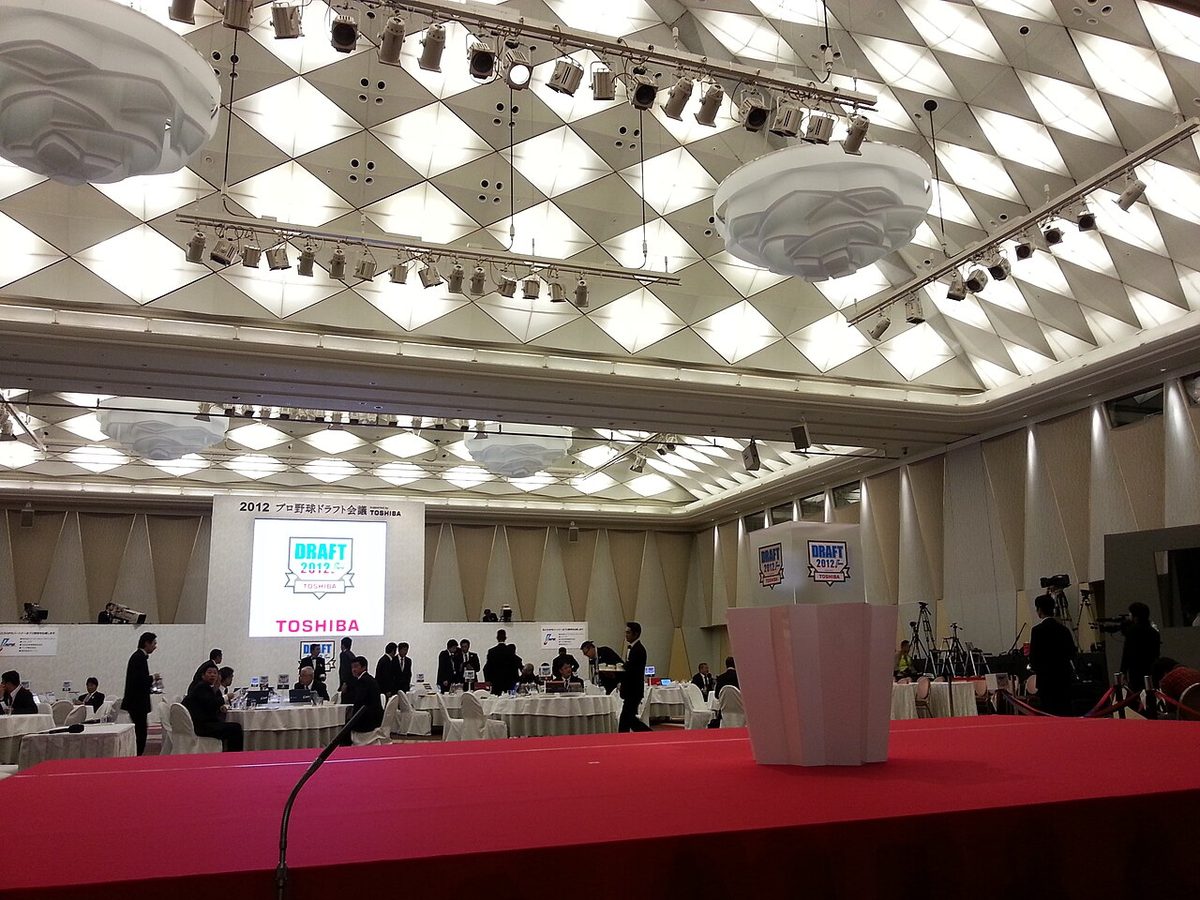
Every October, the 12 teams of Nippon Professional Baseball meet in a hotel in Tokyo. They pick the young players who will join them next year. This is the NPB draft.
Its real name is the “Rookie Selection Meeting.” But almost everyone calls it the draft.
It is a lot like the MLB draft. But there is one big difference. In the first round, teams do not take turns. They all pick at the same time. If two or more teams want the same player, they draw lots. The winning team gets the player. The losing teams pick again.
Here’s the thing. That lottery makes for great TV. Managers reach into a box and pull out a card. One manager cheers. The others look sad. Fans across Japan watch it live.
This page explains how the draft works today. Then it tells the story of how the draft began and how it changed. We also look at the most famous drafts ever.
New to Japanese baseball? Start with how NPB works. For more guides, see our guides page.
Quick Facts
- Official name: The Rookie Selection Meeting.
- When: Every October.
- Where: The Grand Prince Hotel Takanawa, in Tokyo, since 2009.
- First draft: November 17, 1965.
- First round: All teams pick at once. Ties are settled by a lottery.
- Later rounds: Teams take turns.
- Most players: 120 in all. About 10 per team.
- Most teams to pick one player: 8. Hideo Nomo in 1989, and later Hideo Koike.
- Most first-round picks for one player: 3. Suguru Egawa.
Why Japan Has a Draft
Before 1965, there was no draft in Japan. Teams could sign any amateur player they wanted.
That caused two problems. First, rich teams got the best players. Second, teams kept offering more and more money. Signing bonuses got very high.
In 1964, the head of the Nishitetsu Lions had an idea. His name was Mataichiro Nishi. He said Japan should have a draft, like the NFL in America. That would spread the talent around. It would also keep bonuses in check.
The teams agreed. The first draft was held on November 17, 1965.
For a while, there was a cap on bonuses. Up through the 1970s, the most a team could pay a new player was 10 million yen.
Who Can Be Drafted
A player can be drafted if he has never played for an NPB team. He must also be one of these:
- A Japanese citizen.
- Someone who went to a junior high, high school or college in Japan.
So a player from another country can be drafted if he went to school in Japan.
Players can come from many places:
- High school. The player must graduate the next spring.
- College. The player must be in his fourth year.
- Company teams. These are amateur teams run by businesses.
- Independent leagues. These are small pro leagues in Japan, like the Shikoku Island League Plus.
- Players from other countries’ leagues. Japanese players who played pro ball outside Japan can be drafted too.
The Pro Application Form
High school and college players must do one more thing. They must fill out a form that says they want to turn pro. It is called the “pro application form.”
If a student does not hand in the form, teams cannot draft him. This rule began in 2004 for high school players. It began in 2007 for college players.
This way, a student who wants to go to college or get a job will not be drafted by surprise.
Rules for Company Team Players
Company team players have their own rules.
A player who joins a company team out of college must wait two years before he can be drafted. A player who joins out of high school must wait three years.
This gives the company teams time to use the players they sign.
How the First Round Works
The first round is the most exciting part. Here is how it works.
- Each team writes down one player’s name. All teams do this at the same time.
- The names are read out.
- If only one team picked a player, that team gets him.
- If two or more teams picked the same player, they hold a lottery. A person from each team draws an envelope. The one with the winning card gets the player.
- The teams that lost the lottery pick again. They all write down a new name at the same time.
- If there is a tie again, they hold another lottery.
- This keeps going until every team has a first-round player.
This is why a star can be picked by many teams at once. In 1989, eight teams picked Hideo Nomo. Only one could win him. Read his story on our Hideo Nomo page.
How the Later Rounds Work
After the first round, teams take turns. This is called the “waiver” order.
In the second round, the worst team picks first. The best team picks last.
In the third round, the order flips. The best team picks first.
The order keeps flipping each round.
Since 2019, the two leagues take turns getting the first pick in round two. One year the Central League team goes first. The next year, the Pacific League team goes first.
How Many Players Are Picked
The draft ends when every team says it is done, or when 120 players have been picked.
Each team can pick up to 10 players. If the total is under 120, teams can pick more than 10.
Players from independent leagues and from leagues in other countries do not count toward the 120.
The Development Draft
After the main draft, there is a second draft. It is for “development players.”
These players are not on the main roster. They train and play on the farm team. If they do well, the team can sign them to a full contract.
The development draft is only held if fewer than 120 players were picked in the main draft. Teams do not have to take part.
What Happens After the Draft
When a team drafts a player, it wins the right to talk to him about a contract. It does not mean he has signed.
The team cannot trade that right. It cannot give it to another team.
The team has until the end of March the next year to sign the player. If he does not sign, the team loses its rights.
A player can say no. Some players have. They go to college, play for a company team, or wait for the next draft.
How the Draft Has Changed
The NPB draft has changed many times. Here are the big changes.
1965: The first draft. Teams handed in a ranked list of up to 30 players. If two teams had the same player at the top, they held a lottery.
1966: The draft was split into two meetings that year.
1967: The list system ended. A lottery set the order of picks. Teams then took turns.
1978: All teams picked one player at a time, at once. Ties went to a lottery.
1991: The first four rounds were done the old way. After that, teams took turns. That year, teams could no longer sign players outside the draft.
1993: The “reverse nomination” system began. A college or company team player could pick the team he wanted to join. That team could then take him in the first or second round.
2001: Reverse nomination was replaced by the “free acquisition” system. It worked almost the same way.
2005: That system was renamed. Also, the draft was split in two. High school players were drafted in October. College and company players were drafted in November.
2007: A scandal broke. The system that let players pick their team was shut down.
2008: The two drafts were put back together as one.
The 2007 Seibu Scandal
In 2007, NPB found that the Seibu Lions had paid secret cash to amateur players. This was against the rules.
NPB fined Seibu 30 million yen. It also took away Seibu’s top two picks in that year’s high school draft. It was the first time a team lost draft picks as a penalty.
Because of the scandal, NPB ended the system that let players pick their team. Many people felt it had led to secret payments.
You can read more about the team on our Seibu Lions history page.
The Egawa Affair
The most famous draft fight is the Egawa affair.
Suguru Egawa was a star pitcher. He wanted to play for the Yomiuri Giants. But other teams kept drafting him. He was drafted in the first round three times.
In 1978, the Giants found a gap in the rules. A team that drafted a player could only talk to him until two days before the next draft. So there was one day when no team held his rights. People called it “the empty day.”
On that day, the Giants signed Egawa.
The other teams were angry. NPB would not accept the deal. The Giants skipped the draft. At that draft, the Hanshin Tigers drafted Egawa.
In the end, a deal was made. On January 31, 1979, Hanshin signed Egawa. Then it traded him to the Giants that same day. In return, Hanshin got Giants ace Shigeru Kobayashi.
Many fans were upset. Read more on our Yomiuri Giants history page and Hanshin Tigers history page.
The KK Draft of 1985
Another famous draft came in 1985. It was about two high school stars from PL Gakuen. They were Masumi Kuwata and Kazuhiro Kiyohara. People called them the “KK” pair.
Kiyohara wanted to play for the Giants. Kuwata said he would go to college.
On November 20, 1985, the Giants did not pick Kiyohara. They picked Kuwata instead. Six teams picked Kiyohara. The Seibu Lions won him in the lottery.
Kiyohara cried at a press event. Many fans felt the Giants had played a trick.
Kuwata joined the Giants. Kiyohara joined Seibu. In the 1987 Japan Series, Seibu beat the Giants. Kiyohara cried on the field near the end of the last game.
Players Who Said No
Some players have turned down the team that drafted them.
Tomoyuki Sugano. In 2011, he wanted to join the Giants. His uncle, Tatsunori Hara, was the Giants manager. But the Nippon-Ham Fighters won him in the lottery. Sugano said no. He sat out a year. In 2012, the Giants drafted him.
Shohei Ohtani. In 2012, Ohtani said he wanted to go straight to MLB from high school. The Nippon-Ham Fighters drafted him first anyway. After talks, he changed his mind and signed. His plan was to play a few years in Japan, then move to MLB. Read more on our Nippon-Ham Fighters history page.
The Tazawa Rule
In 2008, a pitcher named Junichi Tazawa skipped the NPB draft. He signed with an MLB team instead.
NPB teams did not like that. So they made a rule. If a player turned down the NPB draft to sign with a team in another country, NPB teams could not sign him for a set time after he came back.
People called it the “Tazawa rule.” It lasted from 2008 to 2020.
To learn how players move to MLB today, see our posting system page and our list of NPB players in MLB.
Lottery Mix-Ups
The lottery is simple. But it has gone wrong.
In 2005, two lotteries were read out wrong. In both, the team that lost thought it had won. The results had to be fixed.
In 2015, it happened again. Hanshin and Yakult both picked Shun Takayama. Yakult’s manager, Mitsuru Manaka, pulled a card and threw his fist in the air. But he had misread the card. Hanshin’s manager, Tomoaki Kanemoto, had the winning one. Hanshin got Takayama.
Draft Records
- Most teams to pick one player: 8. Hideo Nomo (1989) and Hideo Koike.
- Most teams to pick one high school player: 7. Kosuke Fukudome and Kotaro Kiyomiya.
- Most first-round picks for one player: 3. Suguru Egawa.
- Most times drafted: 5. Kimiya Fujisawa. He said no four times.
- Youngest player drafted: Kento Tsujimoto, at 15 years and 10 months.
- Oldest player drafted: Noriki Ichimura, at 30 years and 5 months.
- Lowest pick ever: 18th round. Eiji Shimomura, by Hiroshima in 1965.
Great Draft Years
Some draft years had many future stars.
1968. Koji Yamamoto, Koichi Tabuchi, Senichi Hoshino, Hisashi Yamada and Yutaka Fukumoto were all picked. Fukumoto went in the seventh round.
1989. Nomo went to Kintetsu. Other teams that lost the lottery for him took Kazuhiro Sasaki and Satoru Komiyama. Atsuya Furuta went in the second round.
2012. Ohtani, Shintaro Fujinami and Seiya Suzuki were all picked.
Timeline
- 1964: Nishitetsu’s boss proposes a draft.
- 1965: The first draft, on November 17.
- 1967: Teams start to take turns.
- 1978: The Egawa affair. All teams now pick at once.
- 1985: The KK draft.
- 1989: Eight teams pick Hideo Nomo.
- 1991: Signing players outside the draft ends.
- 1993: Players can pick their team.
- 2005: The draft splits in two.
- 2007: The Seibu scandal. The pick-your-team system ends.
- 2008: The draft is one meeting again. The Tazawa rule begins.
- 2009: The draft moves to the Grand Prince Hotel Takanawa.
- 2012: The Fighters draft Ohtani.
- 2019: The leagues take turns picking first in round two.
- 2020: The Tazawa rule ends.
Key Terms
- Rookie Selection Meeting: The official name of the draft.
- Lottery: How ties in the first round are settled.
- Waiver order: The worst team picks first.
- Reverse waiver order: The best team picks first.
- Pro application form: The form students must hand in to be drafted.
- Development player: A player who is not on the main roster. He can be signed to a full contract later.
- Reverse nomination: An old system where a player picked his team.
More terms are in our glossary.
Common Questions
When is the NPB draft? Every October.
How is the NPB draft different from the MLB draft? In the first round, all teams pick at once. Ties are settled by a lottery. In MLB, teams take turns from the start.
Can a drafted player say no? Yes. He can go to college, play for a company team, or wait a year.
Can foreign players be drafted? Only if they went to school in Japan. Other foreign players sign with teams as free agents.
How many players are drafted each year? Up to 120 in the main draft. About 10 per team.
Who was picked by the most teams? Hideo Nomo and Hideo Koike. Eight teams picked each of them.
The Bottom Line
The NPB draft is how Japan’s 12 pro teams pick new players. It is held every October.
The first round is the best part. Every team picks at once. If teams tie, they draw lots. That makes for big drama.
The draft began in 1965. It has changed many times. It has seen fights, like the Egawa affair and the KK draft. And it has seen great stars, like Nomo and Ohtani.
As of the 2025 season, the lottery is still the heart of the draft. And fans still tune in to see who wins.
For more on how Japanese baseball works, see our how NPB works guide.
Sources
- Wikipedia, “Nippon Professional Baseball draft.” https://en.wikipedia.org/wiki/Nippon_Professional_Baseball_draft
- Wikipedia (Japanese), “プロ野球ドラフト会議.” https://ja.wikipedia.org/wiki/プロ野球ドラフト会議
- Wikipedia (Japanese), “江川事件.” https://ja.wikipedia.org/wiki/江川事件
- Wikipedia (Japanese), “KKドラフト事件.” https://ja.wikipedia.org/wiki/KKドラフト事件
- Wikipedia, “Tomoyuki Sugano.” https://en.wikipedia.org/wiki/Tomoyuki_Sugano
- Wikipedia, “Shohei Ohtani.” https://en.wikipedia.org/wiki/Shohei_Ohtani