Japanese Players in MLB › Japanese Pitchers in MLB: A Complete History
Japan has sent a long line of great pitchers to Major League Baseball. Some were starters. Some were closers. A few became stars of the World Series.
It started with one young lefty in 1964. Then came a long wait. Then Hideo Nomo opened the door in 1995. Since then, the line has never stopped.
This page tells the story from the start. We cover the pioneers, the stars, the records and the big contracts. It runs through the 2025 season.
New to Japanese baseball? Read how NPB works first. For more on Japan and MLB, see our MLB page.
Quick Facts
- First Japanese player in MLB: Masanori Murakami, a pitcher, in 1964.
- The door opener: Hideo Nomo, 1995. He won the NL Rookie of the Year.
- First Japanese no-hitter in MLB: Hideo Nomo, 1996.
- Most MLB strikeouts by a Japanese pitcher: Yu Darvish. He was the first to 2,000.
- Biggest deal for a pitcher at the time: Yoshinobu Yamamoto, 12 years, $325 million.
- World Series MVP: Yoshinobu Yamamoto, 2025.
- Rookies of the Year: Hideo Nomo (1995), Kazuhiro Sasaki (2000) and Shohei Ohtani (2018).
Why Japanese Pitchers Do Well
Here’s the thing. Japanese pitchers have a few things going for them.
They throw a lot. In Japan, young pitchers throw a lot in practice. They learn control early.
They have great off-speed pitches. Many Japanese pitchers throw a forkball or a splitter. That pitch dives down just as it reaches the plate. Batters swing over it. MLB hitters are not as used to it.
They pitch on more rest. In Japan, starters usually pitch once a week. In MLB, they pitch every five days. That is a big change. Some pitchers have a hard time with it.
The ball is different. The ball used in Japan is a bit smaller and a bit tackier. So pitchers have to get used to a new ball in MLB.
For more on how the two games differ, see our NPB vs MLB guide.
How They Get to MLB
Most Japanese players can’t just leave for MLB when they want. They are bound to their NPB team for years.
There are two main ways to go.
Free agency. After many years in NPB, a player can become a free agent. Then he can sign with any team, including in MLB.
The posting system. Before that, his NPB team can “post” him. That lets MLB teams try to sign him. If he signs, the MLB team pays a fee to his Japanese team.
Read all about it on our posting system guide.
The Pioneer: Masanori Murakami
The first Japanese player in MLB was a pitcher. His name was Masanori Murakami.
In 1964, he was a young lefty for the Nankai Hawks. Nankai sent him to the United States to learn. He played in the minor leagues for the San Francisco Giants.
He did so well that the Giants called him up. On September 1, 1964, he pitched in his first MLB game. He was the first Japanese player ever in the majors.
He pitched well. In 1964, he gave up just three runs in 15 innings.
But then there was a fight. The Giants wanted to keep him. Nankai wanted him back. In the end, he played one more year for the Giants, in 1965. Then he went home to Japan.
After that, the two leagues made rules to stop this from happening again. It would be 30 years before the next Japanese player came to MLB.
The Door Opener: Hideo Nomo
That next player was Hideo Nomo.
Nomo was a star for the Kintetsu Buffaloes. He had a strange windup. He turned his back to the batter, then spun and threw. Fans called it the “tornado.”
In 1995, he found a way out of his contract in Japan. He signed with the Los Angeles Dodgers.
He was a sensation. He won the National League Rookie of the Year. He was an All-Star. He led the league in strikeouts. Fans in Los Angeles and in Japan went wild. They called it “Nomomania.”
He threw two no-hitters in MLB. The first was in 1996, at Coors Field in Denver. That park is very hard to pitch in. It is still the only no-hitter ever thrown there. The second was in 2001, with the Boston Red Sox.
Nomo showed that a Japanese player could be a star in MLB. After him, many more came. Read his full story on our Hideo Nomo page.
The Closers: Sasaki, Saito, Uehara and More
Some of Japan’s best MLB pitchers have been closers. A closer pitches the last inning of a close game.
Kazuhiro Sasaki was a star closer for the Yokohama BayStars. In 2000, he joined the Seattle Mariners. He won the American League Rookie of the Year. He was an All-Star twice. His forkball was hard to hit.
Takashi Saito came to MLB late. He was 36 when he joined the Dodgers in 2006. He became their closer and an All-Star.
Koji Uehara was a starter in Japan for the Giants. In MLB, he became a top reliever. In 2013, he was the closer for the Boston Red Sox. He was the MVP of the American League Championship Series. Then he got the last out of the World Series.
Hideki Okajima was a reliever for the Red Sox. In 2007, he made the All-Star team. That year, he became the first Japanese-born pitcher to play in the World Series.
Daisuke Matsuzaka
Daisuke Matsuzaka was famous in Japan as a teen. He was a star at Koshien, the big high school tournament. Read about it on our Koshien guide.
He was a star for the Seibu Lions. In 2006, he was the MVP of the first World Baseball Classic. See our Japan WBC history.
After that, Seibu posted him. The Boston Red Sox won the right to sign him. They paid a fee of $51,111,111 just to talk to him.
In 2007, his first year, the Red Sox won the World Series. He was a starter on that team. In 2008, he went 18–3.
He was the first to win both a World Series and a WBC.
Hiroki Kuroda
Hiroki Kuroda was a starter for the Hiroshima Carp. In 2008, he joined the Dodgers. Later, he pitched for the New York Yankees.
He was not flashy. But he was steady. He gave his teams good starts year after year.
Then he did something rare. He went back to the Carp in 2015, at the end of his career. He turned down more money in MLB to do it. Fans in Hiroshima loved him for it. Read about the Carp on our Hiroshima Carp history page.
Yu Darvish
Yu Darvish was the ace of the Nippon-Ham Fighters. He was tall, with many pitches. Read about his Japan years on our Yu Darvish page.
In 2012, he joined the Texas Rangers. In 2013, he led MLB in strikeouts. He was second in the vote for the Cy Young.
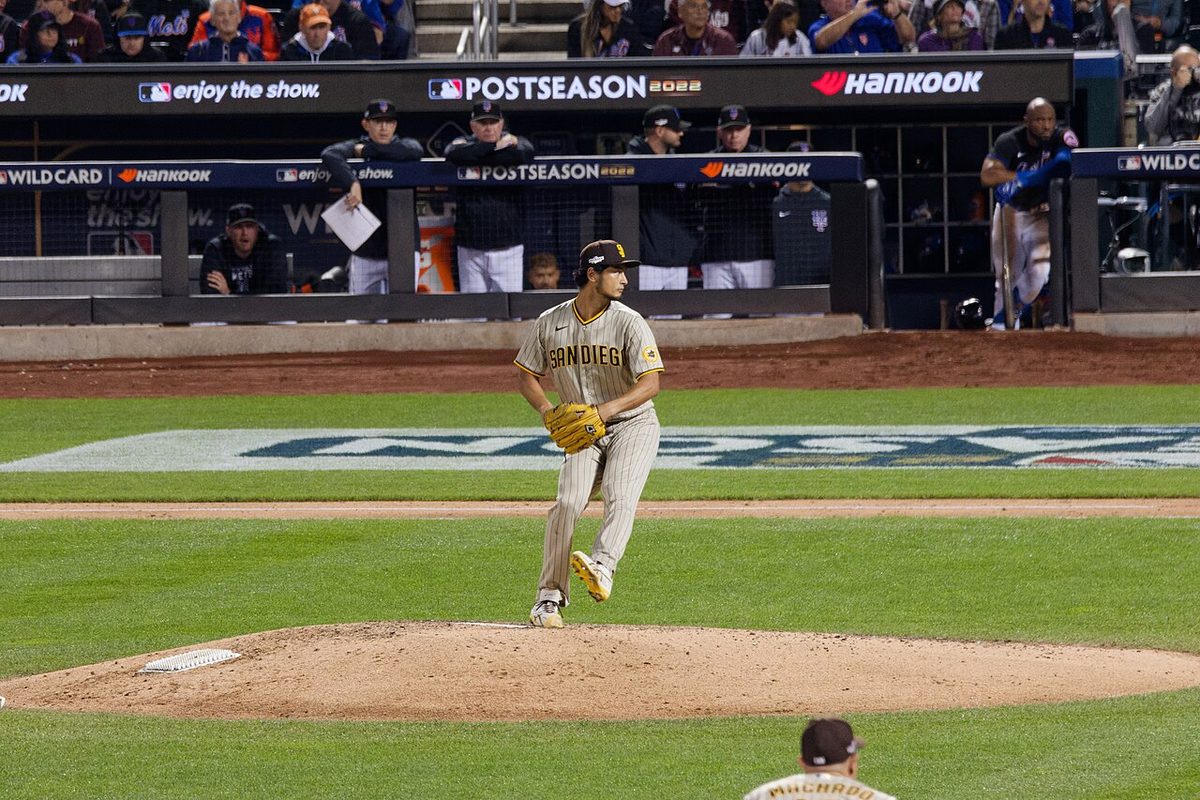
He has pitched for four MLB teams. The last one is the Padres. He pitched in the 2017 World Series for the Dodgers.
Darvish has the most strikeouts by any Japanese pitcher in MLB. He was the first to reach 2,000 strikeouts. We do not list his exact total, because he is still adding to it.
Hisashi Iwakuma
Hisashi Iwakuma was an ace for the Rakuten Eagles. In 2008, he won 21 games in Japan.
In 2012, he joined the Seattle Mariners. On August 12, 2015, he threw a no-hitter against the Baltimore Orioles. He was the second Japanese pitcher to throw one in MLB, after Nomo.
Masahiro Tanaka
Masahiro Tanaka had a year for the ages in Japan. In 2013, he went 24–0 for the Rakuten Eagles. Then he helped them win the Japan Series. See our Japan Series history.
After that, Rakuten posted him. He signed with the New York Yankees for seven years and $155 million. At the time, it was one of the biggest deals ever for a pitcher.
He was the Yankees’ Opening Day starter four times. He was an All-Star twice. In 2021, he went back to Rakuten.
Kenta Maeda
Kenta Maeda was an ace for the Hiroshima Carp. He won the Sawamura Award twice. See our Sawamura Award page.
In 2016, he joined the Dodgers. Later, he pitched for the Minnesota Twins. In 2020, he finished second for the American League Cy Young Award.
Shohei Ohtani
Shohei Ohtani is not just a pitcher. He is also one of the best hitters in the world. He does both. That is very rare.
He was a star for the Nippon-Ham Fighters. In 2016, he helped them win the Japan Series. He was also the Pacific League MVP that year. See our MVP award page.
In 2018, he joined the Los Angeles Angels. He won the American League Rookie of the Year. He was a pitcher and a hitter.
Later, he moved to the Dodgers. His hitting gets most of the headlines. But on the mound, he has been one of the best Japanese pitchers in MLB too. Read more on our page about NPB players in MLB.
Yusei Kikuchi
Yusei Kikuchi was a lefty for the Seibu Lions. In 2019, he joined the Seattle Mariners. He was the first Japanese-born player to make his MLB debut in Japan. It was at the Tokyo Dome, in the 2019 season opener. Read about the park on our Tokyo Dome history page.
He has been an All-Star twice, in 2021 and 2025.
Kodai Senga
Kodai Senga came up the hard way. He started as a low-level player in SoftBank’s system. He worked his way up to become an ace.
His best pitch is a forkball. It drops so much that fans call it the “ghost fork.”
In 2023, he joined the New York Mets. He was an All-Star. He finished second for the National League Rookie of the Year.
Yoshinobu Yamamoto
Yoshinobu Yamamoto may be the best Japanese pitcher of his time.
He pitched for the Orix Buffaloes. From 2021 to 2023, he won the MVP each year. He won the Sawamura Award each year too. He won the pitching Triple Crown all three years. He led the league in wins, strikeouts and ERA. He threw two no-hitters.
He also won Olympic gold with Japan in 2021. See our page on Japan at the Olympics.
After the 2023 season, he signed with the Dodgers. The deal was for 12 years and $325 million. At the time, it was the biggest ever for a pitcher.
In 2024, his first year, the Dodgers won the World Series. In 2025, he was an All-Star for the first time. Then the Dodgers won the World Series again, over the Toronto Blue Jays. Yamamoto was the World Series MVP. Only one Asian player had won it before. That was Hideki Matsui, in 2009.
Shota Imanaga
Shota Imanaga was a lefty for the Yokohama DeNA BayStars. In 2023, he led the Central League in strikeouts.
In 2024, he joined the Chicago Cubs. He was an All-Star in his first year. On September 4, 2024, he faced the Pirates. He did not give up a hit. Two relief pitchers came in to finish it. So it was a no-hitter for all three.
Roki Sasaki
Roki Sasaki throws very hard. In high school, he threw a pitch 163 kilometers per hour. That is about 101 miles per hour.
For the Chiba Lotte Marines, he threw a perfect game on April 10, 2022. In that game, he tied the NPB record for strikeouts in one game. He also set the record for strikeouts in a row.
In 2025, he joined the Dodgers. That year, the Dodgers won the World Series.
Japanese Pitchers and the World Series
Several Japanese pitchers have won the World Series. Here are some of the big moments.
- 2007: Matsuzaka and Okajima win with the Red Sox. Okajima is the first Japanese-born pitcher to pitch in the World Series.
- 2013: Uehara gets the last out for the Red Sox.
- 2024: Yamamoto wins with the Dodgers.
- 2025: Yamamoto is the World Series MVP. Sasaki is on the team too.
A Quick Look Back
Let’s put it all in order.
In the 1960s, there was one. Murakami.
In the 1990s, Nomo came. Others soon followed.
In the 2000s, many more came. Sasaki, Matsuzaka and Uehara were among them.
In the 2010s, the aces came. Darvish, Tanaka, Maeda and Ohtani.
In the 2020s, the best of all may have come. Yamamoto has won it all. And the young ones keep coming.
The Big Contracts
The money for Japanese pitchers has grown a lot.
- Matsuzaka, 2006: The Red Sox paid a posting fee of $51,111,111 just to talk to him.
- Tanaka, 2014: Seven years, $155 million.
- Yamamoto, 2023: Twelve years, $325 million.
These deals show how much MLB teams value Japanese pitchers now.
How to Watch a Japanese Pitcher
Want to enjoy a start by a Japanese pitcher? Here are a few things to watch for.
Watch the split. Look for the pitch that drops at the last second. Count how many batters swing and miss at it.
Watch the pace. Many Japanese pitchers work at a calm, steady pace. Some pause at the top of the windup.
Watch the mix. Many throw five or six kinds of pitches. They change speeds a lot. They try to keep the batter off balance.
Watch the count. Japanese pitchers are taught to throw strikes. They do not like to walk batters.
It is fun to see. And it is a big part of why so many MLB teams now look to Japan for arms.
What Makes the Move Hard
Not every Japanese pitcher has done well in MLB. The move is hard.
- Less rest: A start every five days, not every seven.
- A new ball: The MLB ball feels different.
- Long trips: MLB teams fly across the country. NPB teams mostly ride trains.
- Strong hitters: MLB lineups have power from top to bottom.
- A new life: A new language, new food and time away from family.
The ones who make it often change how they pitch. Some throw fewer innings. Some lean more on their splitter or slider.
Key Terms
- Starter: The pitcher who begins the game.
- Closer: The pitcher who finishes a close game.
- Forkball or splitter: A pitch that drops sharply near the plate.
- No-hitter: A game where a pitcher gives up no hits.
- Posting: The way an NPB team lets an MLB team sign one of its players early.
- Free agent: A player who can sign with any team.
More terms are in our glossary.
Common Questions
Who was the first Japanese pitcher in MLB? Masanori Murakami, in 1964, with the San Francisco Giants.
Who has the most MLB strikeouts by a Japanese pitcher? Yu Darvish. He was the first to reach 2,000.
Has a Japanese pitcher thrown a no-hitter in MLB? Yes. Hideo Nomo threw two. Hisashi Iwakuma threw one. Shota Imanaga started a combined no-hitter.
Has a Japanese pitcher won the Cy Young Award? Not as of the 2025 season. Darvish and Maeda each finished second.
Who was the 2025 World Series MVP? Yoshinobu Yamamoto of the Dodgers.
The Bottom Line
Japanese pitchers have gone from rare to everywhere in MLB. Murakami was first, in 1964. Nomo opened the door in 1995. Since then, many stars have followed. Darvish, Tanaka and Ohtani are just a few.
As of the 2025 season, Yamamoto has won two rings. He was also the MVP of the 2025 World Series. The line of Japanese pitchers in MLB keeps growing.
Sources
- Wikipedia, “List of Major League Baseball players from Japan.” https://en.wikipedia.org/wiki/List_of_Major_League_Baseball_players_from_Japan
- Wikipedia, “Masanori Murakami.” https://en.wikipedia.org/wiki/Masanori_Murakami
- Wikipedia, “Hideo Nomo.” https://en.wikipedia.org/wiki/Hideo_Nomo
- Wikipedia, “Kazuhiro Sasaki.” https://en.wikipedia.org/wiki/Kazuhiro_Sasaki
- Wikipedia, “Koji Uehara.” https://en.wikipedia.org/wiki/Koji_Uehara
- Wikipedia, “Hideki Okajima.” https://en.wikipedia.org/wiki/Hideki_Okajima
- Wikipedia, “Daisuke Matsuzaka.” https://en.wikipedia.org/wiki/Daisuke_Matsuzaka
- Wikipedia, “Yu Darvish.” https://en.wikipedia.org/wiki/Yu_Darvish
- Wikipedia, “Hisashi Iwakuma.” https://en.wikipedia.org/wiki/Hisashi_Iwakuma
- Wikipedia, “Masahiro Tanaka.” https://en.wikipedia.org/wiki/Masahiro_Tanaka
- Wikipedia, “Kenta Maeda.” https://en.wikipedia.org/wiki/Kenta_Maeda
- Wikipedia, “Yusei Kikuchi.” https://en.wikipedia.org/wiki/Yusei_Kikuchi
- Wikipedia, “Kodai Senga.” https://en.wikipedia.org/wiki/Kodai_Senga
- Wikipedia, “Yoshinobu Yamamoto.” https://en.wikipedia.org/wiki/Yoshinobu_Yamamoto
- Wikipedia, “Shota Imanaga.” https://en.wikipedia.org/wiki/Shota_Imanaga
- Wikipedia, “Roki Sasaki.” https://en.wikipedia.org/wiki/Roki_Sasaki