Teams › Tokyo Yakult Swallows: Complete Team History
The Tokyo Yakult Swallows are the other team in Tokyo. The Giants get most of the attention. The Swallows get the fun.
Their fans wave little umbrellas. Their mascot writes jokes on a whiteboard. Their park is an old brick stadium that also hosts college games.
And they win more than you might think. They have six Japan Series titles. That is more than many older teams.
This page tells the whole story. We start with a train in 1950. We go through the lean years, the first title, the Nomura years, and the home run records. At the end, there is a timeline.
Here’s the thing. The Swallows have often been the underdog. Some of their best years came right after their worst ones.
If you are new to how the leagues work, read how NPB works first. All twelve clubs are on our teams page.
Quick Facts
- League: Central League.
- City: Tokyo.
- Founded: January 1950.
- First name: Kokutetsu Swallows.
- First owner: Japanese National Railways.
- Owner since 1970: Yakult, a maker of a probiotic milk drink.
- Home parks: Korakuen Stadium (1950 to 1963). Meiji Jingu Stadium (1964 on).
- Japan Series titles: 6 (through 2025).
- League titles: 9 Central League pennants (through 2025).
- Mascot: Tsubakuro, a swallow.
How the Team Began
In 1949, pro baseball in Japan split into two leagues. New teams were needed.
Japan’s national railway was a giant. It was run by the government. Its workers loved baseball. So groups tied to the railway started a team.
The team was formed in January 1950. It was called the Kokutetsu Swallows. “Kokutetsu” was the short name for Japanese National Railways.
Why a swallow? The railway had a famous express train called the “Tsubame.” That means “swallow” in Japanese. The train was fast and proud. The team took its name.
The first season was in 1950 in the new Central League.
Names and Owners Over the Years
The team has had more names than most.
- 1950 to 1965: Kokutetsu Swallows. Owned by railway groups.
- 1965: Sankei Swallows. The Sankei newspaper took over in the middle of the year.
- 1966 to 1968: Sankei Atoms. The name came from Astro Boy. In Japan, that cartoon hero is called “Atom.”
- 1969: Atoms.
- 1970 to 1973: Yakult Atoms. The drink company Yakult took over.
- 1974 to 2005: Yakult Swallows. The swallow came back.
- 2006 on: Tokyo Yakult Swallows. “Tokyo” was added to tie the team to its city.
Yakult makes a small, sweet milk drink. It is sold all over Asia. The company has owned the team for more than fifty years.
Home Parks
For the first 14 years, the Swallows played at Korakuen Stadium. They shared it with the Giants and other teams.
In 1964, they moved to Meiji Jingu Stadium. They have played there ever since.
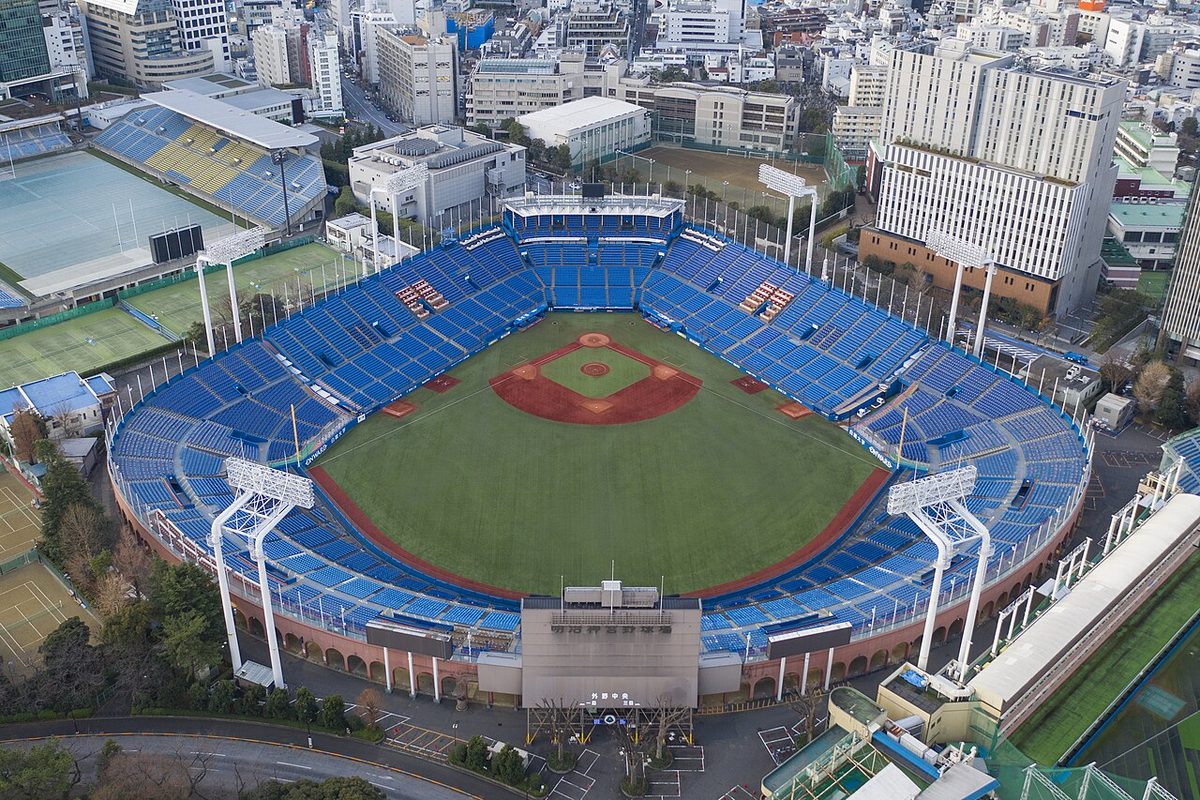
Jingu is an old park. It opened in 1926. It sits in a quiet, leafy part of Tokyo. It was built for college baseball. It still hosts the big Tokyo college league. On some days, a college game is played first. Then the Swallows play at night.
Babe Ruth and Lou Gehrig played at Jingu in 1934 on their tour of Japan.
The park is small. Home runs come easy. That has shaped the team’s history. Big hitters love Jingu.
Kaneda and the Early Years: 1950 to 1964
The early Swallows were not very good. They had little money. They often finished near the bottom.
But they had one of the best pitchers ever. His name was Masaichi Kaneda.
Kaneda was a tall lefty. He threw very hard. He joined the Swallows in 1950, as a teen. He won 20 or more games 14 years in a row, from 1951 to 1964. He won 353 games for the Swallows.
Kaneda was the team. When he pitched, the Swallows had a chance. When he did not, they often lost.
After the 1964 season, he left for the Giants. He finished his career there with 400 wins. That is the most in Japan. You can read more on our Yomiuri Giants history page.
The Atom Years: 1965 to 1977
After Kaneda left, the team went through hard times. It changed owners. It changed names. It lost a lot.
The Sankei paper took over in 1965. Then the drink maker Yakult took over in 1970.
The team kept the Atom name for a few years. But the cartoon’s rights became a problem. In 1974, the team went back to being the Swallows.
Slowly, the team got better. Young hitters came up. Tsutomu Wakamatsu was a small outfielder with a quick bat. He won the batting title twice. Fans loved how much power he got from a small body.
1978: The First Title
In 1976, Tatsuro Hirooka became the manager. He was strict. He changed what players ate. He made them train hard.
In 1978, it paid off. The Swallows won the pennant. It was their first in 29 years. They were the last Central League team to win one.
In the Japan Series, they faced the Hankyu Braves. Hankyu had won three Japan Series in a row. The series went seven games.
In Game 7, a Swallows hitter named Katsuo Osugi hit a long fly ball down the left field line. The umpire called it a home run. Hankyu’s manager said it was foul. He argued for 1 hour and 19 minutes. It is the longest protest in Japan Series history.
The home run stood. The Swallows won the game and their first Japan Series. Wakamatsu was the league MVP that year. An American named Charlie Manuel was also on the team. He later won a World Series as a manager in Philadelphia.
Hirooka would later win titles with the Seibu Lions too. See our Seibu Lions history page.
The Nomura Years: 1990 to 1998
After 1978, the Swallows slid back down. They spent most of the 1980s near the bottom.
In 1990, Katsuya Nomura became the manager. He had been a great catcher for the Nankai Hawks. He was smart and stubborn. He called his style “ID baseball.” ID stood for “important data.” He wanted players to study numbers, pitch types, and patterns.
He also had a young catcher he trusted. His name was Atsuya Furuta. Furuta wore glasses. Some teams had passed on him because of it. Under Nomura, he became one of the best catchers ever in Japan. He was great at throwing out runners.
The Nomura teams won four pennants in nine years.
- 1992: Pennant. Lost the Japan Series to the Seibu Lions in seven games.
- 1993: Pennant. Beat Seibu in seven games. Revenge.
- 1995: Pennant. Beat the Orix BlueWave and a young Ichiro.
- 1997: Pennant. Beat Seibu again.
Stars of those teams included closer Shingo Takatsu, who had a slow, looping sinker. Lefty Kazuhisa Ishii threw hard and struck out a lot of hitters. Shortstop Takahiro Ikeyama hit for power. American Tom O’Malley was the league MVP in 1995.
See our Orix Buffaloes history page for the 1995 series from the other side.
2001: Wakamatsu Wins It
Wakamatsu, the old batting star, became the manager in 1999. In 2001, the Swallows won the pennant. They beat the Kintetsu Buffaloes in the Japan Series, four games to one.
Roberto Petagine led the league in home runs and RBIs that year. See the 2001 title holders page. Ishii led the league in strikeouts in 2000. See the strikeouts title holders page.
The 2000s and 2010s
Furuta became a player-manager in 2006 and 2007. That is rare. He would put himself in the lineup.
New stars came along.
- Norichika Aoki was a slap-hitting outfielder. He won three batting titles. In 2010, he got 209 hits. See the batting average title holders page. He later played in the majors.
- Masanori Ishikawa was a small lefty with soft stuff. He kept pitching into his forties.
- Wladimir Balentien came from Curacao. In 2013, he hit 60 home runs. That broke the old record of 55. It is still the most in one season in Japan. See the 2013 title holders page.
- Tetsuto Yamada was a second baseman. He did a “triple three” three times. That means hitting .300, with 30 homers and 30 steals, in the same year. He did it in 2015, 2016, and 2018. No one else in Japan has done it more than once.
In 2015, the Swallows won the pennant under manager Mitsuru Manaka. They lost the Japan Series to the SoftBank Hawks. See our SoftBank Hawks history page.
Worst to First: 2021
In 2019 and 2020, the Swallows came in last.
Then in 2021, they won it all. The manager was Shingo Takatsu, the old closer.
The Swallows won the pennant. Then they beat the Orix Buffaloes in the Japan Series, four games to two. Five of the six games were decided by one run. Orix had also finished last the year before. It was a worst-to-first matchup on both sides.
Murakami and 56
A young third baseman named Munetaka Murakami became a star in those years.
In 2022, Murakami hit 56 home runs. That was the most ever by a Japanese-born player. It passed Sadaharu Oh’s 55. He also won the Triple Crown at age 22. That means he led the league in batting average, homers, and RBIs. He was the youngest ever to do it.
Fans began calling him “Murakami-sama.” That is a very respectful way to say his name. The phrase became one of the top words of the year in Japan.
See the 2022 title holders page and the home runs title holders page.
The Swallows won the pennant in 2022 too. They faced Orix in the Japan Series again. This time, Orix won.
As of the 2025 season, the Swallows have won 6 Japan Series and 9 Central League pennants.
Eras at a Glance
The railway years. 1950 to 1964. Kaneda carries the team.
The Atom years. 1965 to 1977. New owners. New names. Slow growth.
The first title. 1978. Hirooka wins it all.
The Nomura years. 1990 to 1998. Smart baseball. Three titles.
The slugger years. 2010 to 2022. Aoki, Balentien, Yamada, Murakami. Two more titles.
How to Follow the Swallows
Here are some tips if you are new to this team.
Go to Jingu. It is a short walk from the subway. The park is old and charming. The beer sellers run up and down the aisles.
Bring a small umbrella. You will need it when the Swallows score.
Learn “Tokyo Ondo.” It is short and easy. Everyone sings it.
Look for Tsubakuro. Watch for his whiteboard. His jokes are part of the show.
Pick a player. Follow one young player for a few years. That is how most fans get hooked.
Here’s the thing. The Swallows are a fun team to love. You can laugh at a bad loss and still sing the next night.
Championships
Japan Series titles (6):
- 1970s: 1978.
- 1990s: 1993, 1995, 1997.
- 2000s: 2001.
- 2020s: 2021.
Japan Series losses (3): 1992, 2015, 2022.
Central League pennants (9):
- 1970s: 1978.
- 1990s: 1992, 1993, 1995, 1997.
- 2000s: 2001.
- 2010s: 2015.
- 2020s: 2021, 2022.
Legendary Players
- Masaichi Kaneda. Lefty. 353 wins for the Swallows. 400 in all.
- Tsutomu Wakamatsu. Small but powerful hitter. Later won a title as manager.
- Atsuya Furuta. Catcher. The brain behind the 1990s titles.
- Shingo Takatsu. Closer. Later won a title as manager.
- Kazuhisa Ishii. Hard-throwing lefty. Later pitched in MLB.
- Takahiro Ikeyama. Power-hitting shortstop.
- Norichika Aoki. Three batting titles.
- Masanori Ishikawa. Lefty who pitched for decades.
- Wladimir Balentien. 60 homers in 2013.
- Tetsuto Yamada. Three triple threes.
- Munetaka Murakami. 56 homers and a Triple Crown in 2022.
The Swallows do not have officially retired numbers. Some numbers are kept for special players, but none are retired for good.
Great Managers
- Tatsuro Hirooka. Won the first title in 1978.
- Katsuya Nomura. Four pennants and three Japan Series titles.
- Tsutomu Wakamatsu. Won the 2001 Japan Series.
- Mitsuru Manaka. Won the 2015 pennant.
- Shingo Takatsu. Won the 2021 Japan Series and the 2022 pennant.
Famous Moments
Kaneda’s streak. Fourteen straight 20-win seasons.
The 79-minute protest. Game 7 of the 1978 Japan Series.
Revenge on Seibu. The 1993 Japan Series.
Sixty. Balentien’s record in 2013.
Worst to first. The 2021 title.
Murakami-sama. The 56-homer season in 2022.
Rivalries
The Yomiuri Giants. Both teams are in Tokyo. The parks are only a few miles apart. The Giants are the big brother. The Swallows love to beat them.
The Seibu Lions. The two met in the Japan Series in 1992, 1993, and 1997. See our Seibu Lions history page.
The Orix Buffaloes. Two straight Japan Series, in 2021 and 2022. Even the mascots have a feud.
Culture, Mascot and Cheering
The umbrella dance. This is the Swallows’ most famous tradition. When the team scores, fans open small umbrellas. They wave them up and down. They sing an old song called “Tokyo Ondo.” Most fans use small plastic umbrellas in green or blue. The team also sells tiny ones.
The song was first used at games by the old Tokyo Orions. That team later moved and became the Chiba Lotte Marines. Swallows fans kept the song alive. See our Chiba Lotte Marines history page.
No balloons. Many teams let fans send up balloons in the seventh inning. Jingu Stadium has not allowed them since 2009. Swallows fans are fine with it. They have umbrellas.
The mascot. Tsubakuro is a black swallow with a red face. He became the team’s mascot in 1994. He does not talk. He writes on a little whiteboard. His jokes are dry and sometimes rude. He has a running feud with the Orix mascots. There is also a female swallow named Tsubami.
The songs. The team song is “Seishun no Diamond.” Fans also sing older cheer songs and a song for each player. The trumpets in the outfield play all game long.
College ball. Jingu is still a college park too. The two crowds sometimes cross paths on the same day.
Timeline
- 1950: The Kokutetsu Swallows are founded. Kaneda joins.
- 1951 to 1964: Kaneda wins 20 or more games 14 years in a row.
- 1964: Move to Jingu Stadium.
- 1965: Kaneda leaves. Sankei takes over.
- 1966: Sankei Atoms.
- 1970: Yakult takes over.
- 1974: Back to the Swallows name.
- 1976: Hirooka becomes manager.
- 1978: First pennant and first Japan Series title.
- 1990: Nomura becomes manager. Furuta joins.
- 1992: Pennant.
- 1993: Japan Series title.
- 1995: Japan Series title.
- 1997: Japan Series title.
- 2001: Japan Series title under Wakamatsu.
- 2006: Name becomes Tokyo Yakult Swallows. Furuta becomes player-manager.
- 2013: Balentien hits 60.
- 2015: Pennant. Yamada’s first triple three.
- 2021: Worst to first. Sixth Japan Series title.
- 2022: Pennant. Murakami hits 56.
- As of 2025: 6 Japan Series titles and 9 pennants.
Key Terms
Kokutetsu. Japanese National Railways. The team’s first owner.
Tsubame. “Swallow.” A famous express train, and the source of the team’s name.
Jingu. Meiji Jingu Stadium, the team’s home since 1964.
ID baseball. Nomura’s data-based style.
Triple three. Hitting .300 with 30 homers and 30 steals in the same year.
Tokyo Ondo. The old song fans sing while waving umbrellas.
Common Questions
How many Japan Series have the Swallows won? Six, as of the 2025 season.
Why do Swallows fans wave umbrellas? It is their way to celebrate a run. They sing “Tokyo Ondo” while they do it.
Who holds the Japan record for home runs in one season? Wladimir Balentien of the Swallows, with 60 in 2013.
Where do the Swallows play? At Meiji Jingu Stadium in Tokyo, since 1964.
Who is Tsubakuro? The team’s swallow mascot. He writes jokes on a whiteboard.
The Bottom Line
The Swallows started as a railway team with one great pitcher. They changed owners and names. They lost a lot. Then they found good managers, smart catchers, and big bats. Now they have six Japan Series titles.
There is a lesson in that. Being the second team in a big city is not a curse. You just have to find your own way to win, and your own way to have fun.
See all the clubs on our teams page. For stat leaders by year, see the title holders hub.
Sources
- Wikipedia, “Tokyo Yakult Swallows.” https://en.wikipedia.org/wiki/Tokyo_Yakult_Swallows
- Wikipedia (Japanese), “東京ヤクルトスワローズ.” https://ja.wikipedia.org/wiki/東京ヤクルトスワローズ
- Wikipedia, “Japan Series.” https://en.wikipedia.org/wiki/Japan_Series
- Wikipedia, “Central League.” https://en.wikipedia.org/wiki/Central_League
- Wikipedia, “Meiji Jingu Stadium.” https://en.wikipedia.org/wiki/Meiji_Jingu_Stadium
- Tokyo Yakult Swallows official site. https://www.yakult-swallows.co.jp/
- MLB.com, coverage of Norichika Aoki, Kazuhisa Ishii and Munetaka Murakami. https://www.mlb.com/
- ESPN, coverage of Balentien’s 60-homer season. https://www.espn.com/
- Japan Times, baseball section. https://www.japantimes.co.jp/sports/baseball/