Teams › Orix Buffaloes: Complete Team History
The Orix Buffaloes are really two old teams in one.
One is the Hankyu Braves. They were a train company’s team from the Osaka area. They started in 1936. Later they became the Orix BlueWave, the team of a young Ichiro.
The other is the Kintetsu Buffaloes. They were another train company’s team from Osaka. They began in 1949. They were famous for heartbreak.
In 2004, the two teams merged. The result is the Orix Buffaloes.
This page tells the whole story. We cover both teams. We go through the Braves’ titles. We meet Ichiro. We cover the quake year, Kintetsu’s wild finishes, the merger, and the new title teams. At the end, there is a timeline.
Here’s the thing. This franchise has known long droughts, big crowds, empty seats, and great stars. It has done almost everything a team can do.
If you are new to how the leagues work, read how NPB works first. All twelve clubs are on our teams page.
Quick Facts
- League: Pacific League.
- City: Osaka, with some games in Kobe.
- Founded: January 23, 1936, as the Hankyu club.
- Owner: Orix, a finance company, since late 1988.
- Home parks: Nishinomiya Stadium (1937 to 1990). Green Stadium Kobe (1991 to 2004). Osaka Dome (2005 on, with some games in Kobe).
- Japan Series titles: 5 (1975, 1976, 1977, 1996, 2022).
- League titles: 15 Pacific League pennants (through 2025).
- Mascots: Buffalo Bull and Buffalo Bell.
How the Team Began
In the 1930s, train lines grew fast around Osaka. They built lines, stores, and fun places to go at the end of the line.
The head of the Hankyu train company was Ichizo Kobayashi. He was a famous businessman. He had started the Takarazuka Revue, a famous all-female theater group.
In December 1935, a rival train company, Hanshin, started a team. That team is now the Hanshin Tigers.
Kobayashi did not want to be left behind. He was on a trip to America when he heard the news. He sent word home right away: start a team, and build a ballpark.
The Hankyu club was formed on January 23, 1936. It was one of the first teams in Japan’s first pro league.
Kobayashi loved the team. He once said the company must never sell two things, even after he died. One was the Revue. The other was the Braves.
Names and Owners Over the Years
- 1936 to 1946: Hankyu.
- 1947: Hankyu Bears, for a few months.
- 1947 to 1988: Hankyu Braves.
- 1989 to 1990: Orix Braves. A finance company called Orix bought the team.
- 1991 to 2004: Orix BlueWave. The team moved to Kobe.
- 2005 on: Orix Buffaloes. After the merger with Kintetsu.
In 1988, Hankyu sold the team to Orix after all. It happened just about fifty years after the club began.
Home Parks
Nishinomiya Stadium. Hankyu built this park and opened it in 1937. It was in Nishinomiya, between Osaka and Kobe. It was the Braves’ home for decades.
Green Stadium Kobe. In 1991, the team moved to a new park in Kobe. It had natural grass and a pretty setting. It has had sponsor names too. One is Hotto Motto Field Kobe. Fans still love it. The Buffaloes still play some games there.
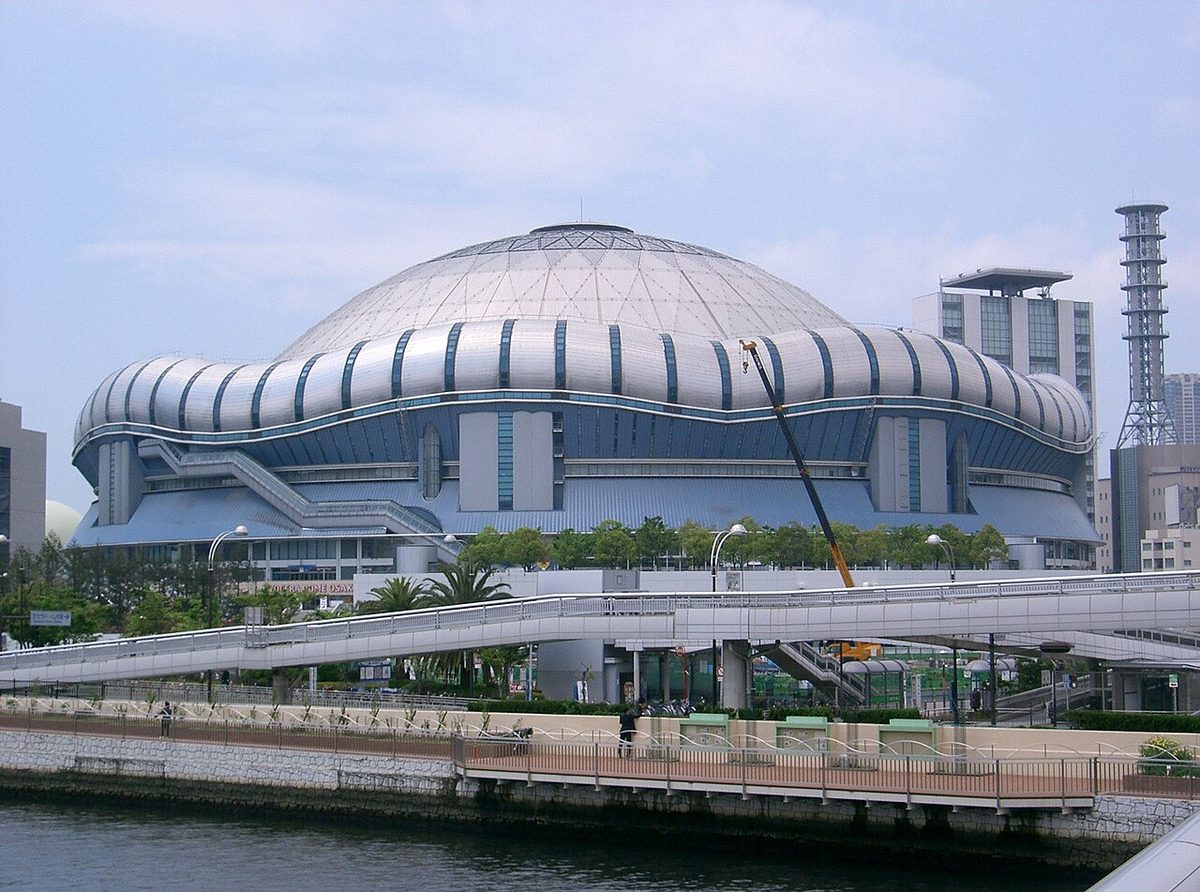
Osaka Dome. After the merger in 2005, the main home became the Osaka Dome. That had been Kintetsu’s park. It has also carried sponsor names, such as Kyocera Dome Osaka.
The Lean Years: 1936 to 1966
The Hankyu team was not good for a long time. It finished in the middle or the bottom year after year.
In 1950, the league split in two. Hankyu joined the Pacific League. It still did not win.
The Braves went 31 years without a title. No team in Japan has waited longer for its first pennant. It was a long, slow time. Fans called the team “the gray Braves,” because it was so dull.
Nishimoto Builds a Winner
In 1963, Yukio Nishimoto became the manager. He had already won a pennant with the Daimai Orions. He was a strict teacher. He worked his players hard. He was famous for being tough but fair.
In 1967, the Braves finally won the pennant. They won again in 1968, 1969, 1971, and 1972.
But every time, they faced the Yomiuri Giants in the Japan Series. These were the Giants of V9, who won nine Japan Series in a row. The Braves lost all five times. See our Yomiuri Giants history page.
Ueda and Three Straight Titles: 1975 to 1977
In 1974, Toshiharu Ueda took over. He was young and smart. He kept the strong team Nishimoto had built and made it even better.
The Braves had great players. Here are a few.
- Yutaka Fukumoto was a small, fast leadoff man. In 1972, he stole 106 bases. That is still the Japan record for one season. He stole 1,065 in his career. That was a world record at the time.
- Hisashi Yamada was a submarine pitcher. He threw from very low, almost scraping the ground. He won 284 games.
- Takashi Yamaguchi was a hard-throwing young pitcher. Some said he threw as fast as anyone of his time.
- Tokuji Nagaike was the slugger of the early 1970s.
In 1975, the Braves won their first Japan Series. They beat the Hiroshima Carp. In 1976 and 1977, they beat the Giants. At last.
That made three Japan Series titles in a row.
In 1978, they won the pennant again. They faced the Yakult Swallows. In Game 7, a Swallows hitter hit a long fly down the line. The umpire called it a home run. Ueda said it was foul. He argued for 1 hour and 19 minutes. The call stood, and the Swallows won. See our Yakult Swallows history page.
In 1984, the Braves won one more pennant. Boomer Wells, a big first baseman from Alabama, won the Triple Crown. He was the first foreign player in Japan to do it. The Braves lost the Japan Series to the Carp in seven games. See our Hiroshima Carp history page.
Hankyu Sells the Team
In October 1988, Hankyu sold the Braves to Orix. On almost the same day, Nankai sold the Hawks to Daiei. Two old Osaka teams changed hands at once. Fans were stunned.
The team kept the Braves name for two years. Then it moved to Kobe in 1991. It got a new name: the Orix BlueWave.
Ichiro and Ogi
In 1994, Akira Ogi became the manager. He saw a thin young outfielder. The kid had been stuck in the minors. Ogi liked his swing. The young man was named Ichiro Suzuki.
Ogi put him in the lineup every day. He also had an idea for the jersey. It would say just “Ichiro.” No last name.
In 1994, Ichiro got 210 hits. No one in Japan had ever gotten 200 in a season. He won the batting title. He won the MVP. He won the batting title seven years in a row. That ran from 1994 to 2000. He won the MVP three years in a row too. See the 2000 title holders page.
1995: “Ganbaro Kobe”
On January 17, 1995, a huge earthquake struck Kobe. More than 6,000 people died. Much of the city was destroyed.
Some people thought the BlueWave should leave Kobe for the season. Ogi said no. He said the team should play in Kobe as planned, even if no fans came.
The team wore a patch on its sleeves. It said “Ganbaro Kobe.” That means “Hang in there, Kobe.”
The BlueWave won the pennant in 1995. It was a gift to a hurting city. People cried in the stands. Some had lost homes. Some had lost family. The team gave them a reason to smile. They lost the Japan Series to the Swallows.
In 1996, they won the pennant again. This time they beat the Giants in the Japan Series. They won the title at home in Kobe.
After 2000, Ichiro left for Seattle. He went through the posting system. See our guide to the posting system.
The Kintetsu Story
Now we go back and pick up the other half of the family.
The Kintetsu Buffaloes began in 1949. The Kintetsu train company started the team. It played its first season in 1950 as the Kintetsu Pearls. Later it became the Kintetsu Buffalo, and then the Kintetsu Buffaloes.
For thirty years, Kintetsu never won the pennant.
Then Yukio Nishimoto, the old Braves manager, took over. He built Kintetsu into a winner. The Buffaloes won the pennant in 1979 and 1980. But both times, they lost the Japan Series to the Carp in seven games. The 1979 loss came in a famous ninth inning. Kintetsu loaded the bases. Carp closer Yutaka Enatsu got out of it.
Keishi Suzuki, a lefty ace, won 317 games for Kintetsu.
On October 19, 1988, Kintetsu played a doubleheader at Kawasaki against Lotte. It had to win both to take the pennant. It won the first. The second ended in a tie because of a time limit. Kintetsu missed the pennant by a hair. Fans call it “10.19.” See our Chiba Lotte Marines history page.
In 1989, Kintetsu won the pennant. It won the first three games of the Japan Series against the Giants. Then it lost four in a row.
Hideo Nomo pitched for Kintetsu from 1990 to 1994. He threw a “tornado” windup. In 1995, he left for the Los Angeles Dodgers. He opened the door for many Japanese players to go to MLB. See our guide on NPB players in MLB.
In 2001, Kintetsu won one more pennant. Tuffy Rhodes hit 55 home runs. The title was clinched in a wild way. A pinch hitter named Takashi Kitagawa hit a walk-off grand slam. It came with the team behind. See the 2001 title holders page. Kintetsu lost the Japan Series to the Swallows.
Kintetsu never won a Japan Series. It came close. It never got there. Fans still talk about what might have been.
The 2004 Merger
In 2004, Kintetsu was losing money. It planned to merge with Orix. Some owners wanted to cut the leagues down to fewer teams. Players and fans pushed back. The players went on strike for two days in September. It was the first strike in Japanese pro baseball history.
In the end, the merger went ahead. But a new team, the Rakuten Golden Eagles, was added. That kept the Pacific League at six teams. See our Rakuten Eagles history page.
The new team took Kintetsu’s name, Buffaloes, and Orix’s ownership. Players from both teams were split up. Some went to the new Rakuten team.
Ogi came back to manage in 2005. He died that December.
The Buffaloes: 2005 to 2020
The new Buffaloes had a hard time for years. They were near the bottom a lot. Crowds were small. Not every old fan came along.
There were bright spots.
- Chihiro Kaneko won the Sawamura Award in 2014. See the ERA title holders page.
- Takahiro Okada led the league in home runs in 2010.
- Yoshio Itoi won the batting title in 2014.
In 2020, the Buffaloes came in last.
Three Straight Pennants: 2021 to 2023
Then came a turnaround. Satoshi Nakajima became the manager. He trusted young players.
In 2021, the Buffaloes went from last to first. They won the pennant. They lost the Japan Series to the Swallows. Both teams had come in last the year before.
In 2022, they won the pennant again. They met the Swallows again. This time, the Buffaloes won. It was their first Japan Series title in 26 years.
In 2023, they won a third straight pennant. They lost the Japan Series to the Hanshin Tigers in seven games. It was an all-Kansai series. See our Hanshin Tigers history page.
The stars of those teams:
- Yoshinobu Yamamoto was the ace. He won the Sawamura Award three years in a row, from 2021 to 2023. He led the league in wins, ERA, and strikeouts in each of those years. He threw a no-hitter in 2022 and another in 2023. Then he signed with the Los Angeles Dodgers. See the wins title holders page.
- Masataka Yoshida won two batting titles. Then he went to the Boston Red Sox.
- Hiroya Miyagi was a young lefty starter.
- Yutaro Sugimoto led the league in home runs in 2021.
As of the 2025 season, the franchise has won 5 Japan Series and 15 Pacific League pennants.
Eras at a Glance
The gray years. 1936 to 1966. No pennants. Small crowds.
The Nishimoto years. 1963 to 1973. Five pennants. Five losses to the Giants.
The Ueda years. 1974 to 1978 and beyond. Three straight titles.
The Kobe years. 1991 to 2004. Ichiro. The quake. The 1996 title.
The Kintetsu story. 1950 to 2004. Four pennants. No titles. Lots of drama.
The Buffaloes. 2005 on. Hard years first. Then three straight pennants.
How to Follow the Buffaloes
Here are some tips if you are new to this team.
Go to Osaka. Most home games are at the dome. It is easy to reach by train.
Try a game in Kobe. A few games each year are in Kobe. The park has real grass. It is where Ichiro played.
Learn both family trees. Some fans grew up with Hankyu. Some grew up with Kintetsu. Both are part of this team now.
Watch the pitchers. This club has a habit of finding great arms. Keep an eye on the young ones.
Pick a player. Follow one player for a few years. That is the best way to care.
Here’s the thing. This team has two pasts. You can love both.
Championships
These counts follow the Hankyu-Orix line. Kintetsu’s pennants are listed apart.
Japan Series titles (5):
- 1970s: 1975, 1976, 1977.
- 1990s: 1996.
- 2020s: 2022.
Japan Series losses (10):
- 1960s: 1967, 1968, 1969.
- 1970s: 1971, 1972, 1978.
- 1980s: 1984.
- 1990s: 1995.
- 2020s: 2021, 2023.
Pacific League pennants (15):
- 1960s: 1967, 1968, 1969.
- 1970s: 1971, 1972, 1975, 1976, 1977, 1978.
- 1980s: 1984.
- 1990s: 1995, 1996.
- 2020s: 2021, 2022, 2023.
Kintetsu’s pennants (4): 1979, 1980, 1989, 2001. Kintetsu lost all four Japan Series.
Legendary Players
- Yutaka Fukumoto. 106 steals in 1972. 1,065 in his career.
- Hisashi Yamada. Submarine ace. 284 wins.
- Tokuji Nagaike. Slugger of the Braves’ title years.
- Boomer Wells. Triple Crown in 1984.
- Keishi Suzuki. Kintetsu ace. 317 wins.
- Hideo Nomo. Kintetsu ace. The tornado.
- Ichiro Suzuki. Seven straight batting titles.
- Tuffy Rhodes. 55 homers for Kintetsu in 2001.
- Chihiro Kaneko. Sawamura Award in 2014.
- Yoshinobu Yamamoto. Three straight Sawamura Awards.
- Masataka Yoshida. Two batting titles.
The team has no retired numbers.
Great Managers
- Yukio Nishimoto. Five Braves pennants and two Kintetsu pennants. He never won a Japan Series.
- Toshiharu Ueda. Three straight Japan Series titles.
- Akira Ogi. Ichiro’s manager. The 1996 title.
- Satoshi Nakajima. Three straight pennants and the 2022 title.
Famous Moments
106. Fukumoto’s steals in 1972.
Beating the Giants. The 1976 and 1977 Japan Series.
10.19. Kintetsu’s near miss in 1988.
210 hits. Ichiro in 1994.
Ganbaro Kobe. The 1995 pennant after the earthquake.
The grand slam. Kitagawa’s pennant clincher in 2001.
Worst to first. The 2021 pennant.
Rivalries
The Hanshin Tigers. The Hankyu and Hanshin train lines ran side by side. Today, the two companies are part of one group. The teams’ games are called the “Kansai Classic.”
The Swallows. Japan Series in 1978, 1995, 2021, and 2022. Even their mascots feud.
The SoftBank Hawks. An old rival from the Osaka days.
Culture, Mascot and Cheering
The mascots. Buffalo Bull and Buffalo Bell are a brother and sister. Bull is the strong one. Bell is the “bell of victory.” They wear numbers 111 and 222. They have a famous running feud with Tsubakuro, the Swallows’ mascot.
The songs. In the Hankyu days, a brass band played a song for each hitter. It was like a high school game. Some of those songs are still used. The modern song “SKY” plays in the seventh inning and after wins.
The balloons. Fans send up balloons in the seventh inning. The colors have changed over the years. For a while they were red and blue, for Kintetsu and Orix. Later they were blue and gold. Then white.
The colors. Navy blue and gold.
Two homes. Most games are in Osaka. But some are in Kobe, where Ichiro played. On those days, the team sometimes wears old BlueWave uniforms.
Timeline
- 1936: The Hankyu club is founded on January 23.
- 1937: Nishinomiya Stadium opens.
- 1947: Name becomes Hankyu Braves.
- 1949: Kintetsu forms its team.
- 1950: Both join the Pacific League.
- 1963: Nishimoto takes over Hankyu.
- 1967: Hankyu’s first pennant.
- 1972: Fukumoto steals 106.
- 1975 to 1977: Three straight Japan Series titles.
- 1979 and 1980: Kintetsu pennants.
- 1984: Boomer’s Triple Crown. Pennant.
- 1988: Hankyu sells to Orix. Kintetsu’s 10.19.
- 1989: Kintetsu pennant.
- 1991: Move to Kobe. Orix BlueWave.
- 1994: Ichiro’s 210 hits.
- 1995: Earthquake. “Ganbaro Kobe.” Pennant.
- 1996: Japan Series title.
- 2001: Kintetsu pennant. Rhodes hits 55.
- 2004: Merger. Players strike.
- 2005: Orix Buffaloes begin.
- 2021: Worst to first.
- 2022: Japan Series title.
- 2023: Third straight pennant.
- As of 2025: 5 Japan Series titles and 15 pennants.
Key Terms
Hankyu. The train company that started the Braves.
Kintetsu. The train company that started the Buffaloes.
BlueWave. The team’s name in Kobe, from 1991 to 2004.
Ganbaro Kobe. “Hang in there, Kobe.” The 1995 slogan.
10.19. Kintetsu’s doubleheader on October 19, 1988.
Kansai. The region around Osaka, Kobe, and Kyoto.
Common Questions
Is Orix the same team as Kintetsu? Partly. Orix merged with Kintetsu in 2004. The franchise line runs through Hankyu and Orix. Kintetsu’s name and fans came along.
Did Ichiro play for Orix? Yes, from 1992 to 2000. He became a star in 1994.
How many Japan Series has this franchise won? Five, as of the 2025 season.
Did Kintetsu ever win the Japan Series? No. It made it four times and lost all four.
Where do the Buffaloes play? Mostly at the Osaka Dome, with some games in Kobe.
The Bottom Line
This franchise has two family trees. One had three straight titles in the 1970s and Ichiro in the 1990s. The other had heartbreak after heartbreak. Together, they built the team that won three straight pennants in the 2020s.
There is a lesson in that. Two stories can become one. The best parts of each can carry on.
See all the clubs on our teams page. For stat leaders by year, see the title holders hub.
Sources
- Wikipedia, “Orix Buffaloes.” https://en.wikipedia.org/wiki/Orix_Buffaloes
- Wikipedia (Japanese), “オリックス・バファローズ.” https://ja.wikipedia.org/wiki/オリックス・バファローズ
- Wikipedia, “Osaka Kintetsu Buffaloes.” https://en.wikipedia.org/wiki/Osaka_Kintetsu_Buffaloes
- Wikipedia, “2004 Nippon Professional Baseball realignment.” https://en.wikipedia.org/wiki/2004_Nippon_Professional_Baseball_realignment
- Wikipedia, “Japan Series.” https://en.wikipedia.org/wiki/Japan_Series
- Wikipedia, “Pacific League.” https://en.wikipedia.org/wiki/Pacific_League
- Orix Buffaloes official site. https://www.buffaloes.co.jp/
- MLB.com, coverage of Ichiro Suzuki, Yoshinobu Yamamoto and Masataka Yoshida. https://www.mlb.com/
- ESPN, coverage of the 2004 players’ strike. https://www.espn.com/
- Japan Times, baseball section. https://www.japantimes.co.jp/sports/baseball/