Teams › Tohoku Rakuten Golden Eagles: Complete Team History
The Tohoku Rakuten Golden Eagles are the youngest team in Japanese pro baseball. They played their first game in 2005.
They were born out of a crisis. In 2004, two teams merged, and the league almost shrank. The players went on strike. In the end, a new team was added to keep the numbers even. That team was the Eagles.
Their first season was one of the worst in history. Six years later, a huge earthquake and tsunami hit their home region. Two years after that, they won it all.
This page tells the whole story. We start with the 2004 crisis. We go through the hard first years, Nomura, the disaster, Masahiro Tanaka’s perfect season, and the title. At the end, there is a timeline.
Here’s the thing. The Eagles’ story is short. But it may be the most moving story of any team in Japan.
If you are new to how the leagues work, read how NPB works first. All twelve clubs are on our teams page.
Quick Facts
- League: Pacific League.
- City: Sendai, in Miyagi.
- Region: Tohoku. That is the northeast part of Japan’s main island.
- Founded: Approved on November 2, 2004.
- First season: 2005.
- Owner: Rakuten, an online shopping and tech company.
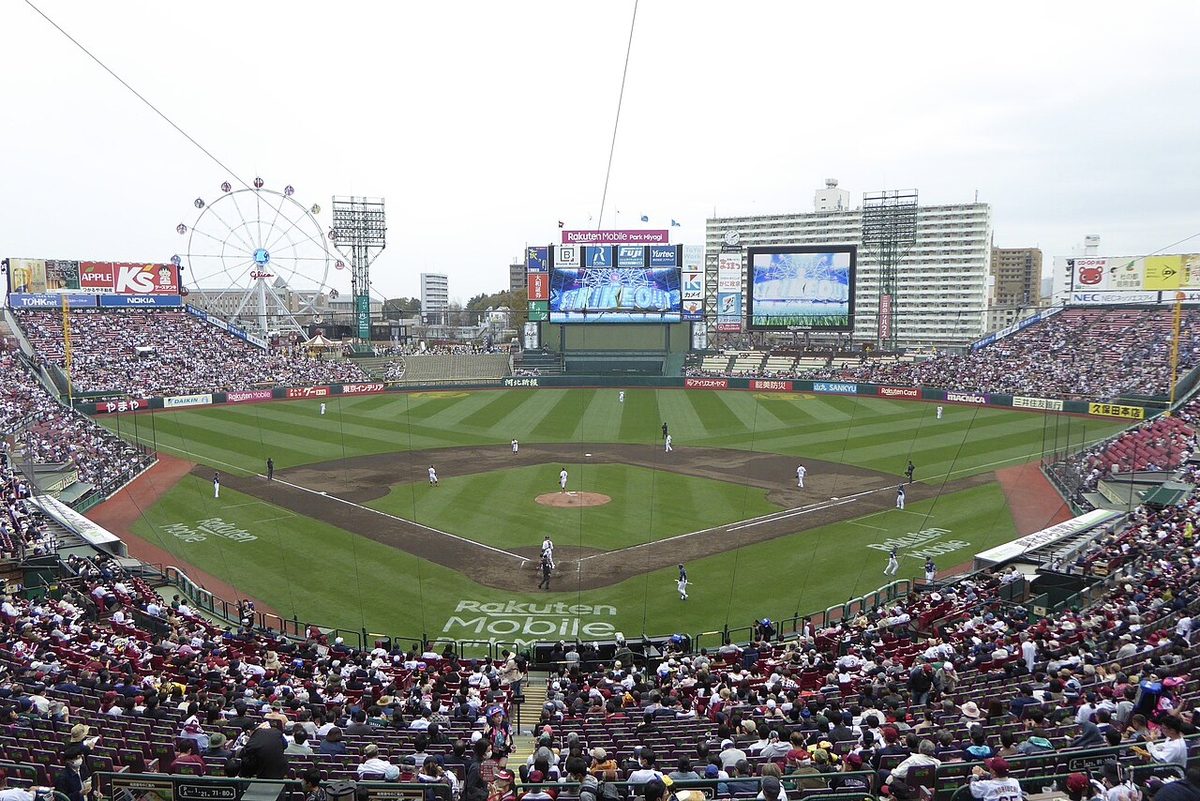
- Home park: Miyagi Stadium in Sendai. It has had many sponsor names.
- Japan Series titles: 1 (2013).
- League titles: 1 Pacific League pennant (2013).
- Mascots: Clutch and Clutchina, two golden eagles. Also Switch, and a cheeky crow called Mr. Karasuko.
- Team song: “Habatake Rakuten Eagles.”
- Retired number: No. 10, for the fans.
How the Team Began: The 2004 Crisis
In 2004, the Kintetsu Buffaloes were losing money. Kintetsu planned to merge its team with the Orix BlueWave.
That would leave only five teams in the Pacific League. Some team owners wanted to go further. They talked about cutting down to one league of ten teams.
The players said no. They feared fewer teams would mean fewer jobs and a weaker game. Fans agreed. In September 2004, the players went on strike for two days. It was the first strike in Japanese pro baseball history.
In the end, the owners gave in on one key point. The merger went ahead, but a new team would be added. That kept twelve teams and two leagues.
Two companies wanted the new team. One was an internet company called Livedoor. The other was Rakuten, another internet company. Both wanted to put a team in Sendai.
On November 2, 2004, the owners chose Rakuten. It was the first new team in Japan’s top league in fifty years.
You can read about the merger from the other side on our Orix Buffaloes history page.
The Name
The team’s full name has three parts.
- Tohoku is the region. Rakuten wanted the whole northeast to feel like the team was theirs, not just Sendai.
- Rakuten is the owner. The word means “optimism” in Japanese.
- Golden Eagles is the nickname. The golden eagle lives in the mountains of Tohoku.
The name has not changed since the team began.
Home Park
The Eagles play at the old Miyagi Stadium in Sendai. It opened in 1950. Other pro teams had used it before. In the 1970s, it was a main base for the Lotte Orions. See our Chiba Lotte Marines history page.
When Rakuten took over, the park was old and small. Rakuten fixed it up before the first season. Over the years, it has been expanded many times. It has had many sponsor names too.
In 2016, the team added a small amusement park in the outfield area, with a Ferris wheel. Kids can ride it during games. Fans can see the field from the top.
2005: A Rough First Year
The Eagles were built from leftovers. After the merger, the Orix Buffaloes got first pick of the players from both old teams. The Eagles got the rest.
Their first game was on March 26, 2005, against Lotte. Ace Hisashi Iwakuma pitched. The Eagles won, 3 to 1. Fans were thrilled.
The next day, they lost 26 to 0.
That set the tone. The Eagles won 38 games and lost 97 that year. The manager, Yasushi Tao, was let go after one season.
Still, people came. Sendai had its own team now. Fans filled the park even in the bad times.
The Nomura Years: 2006 to 2009
In 2006, Katsuya Nomura became the manager. He was 70 years old. He had been a great catcher and a great manager for the Hawks, the Swallows, and the Tigers. He was famous for his sharp mind and his grumpy jokes.
Nomura taught the young team how to think about the game.
That same year, the team drafted a high school pitcher named Masahiro Tanaka. He had been a star at the national high school tournament. See our guide Koshien explained. Fans called him “Ma-kun.” He won Rookie of the Year in 2007.
A veteran slugger named Takeshi Yamasaki had a late-career boom. In 2007, at age 38, he led the league in home runs and RBIs. See the 2007 title holders page.
In 2008, Iwakuma won 21 games and the Sawamura Award. See the 2008 title holders page.
In 2009, the Eagles finished second. It was their first winning season. They made the playoffs for the first time.
March 11, 2011
On March 11, 2011, a huge earthquake struck off the coast of Tohoku. A giant tsunami followed. It killed more than 15,000 people. Whole towns along the coast were destroyed. A nuclear plant was badly damaged.
The Eagles were away at spring training. Their park in Sendai was damaged. Many players had family and friends in the region.
The team could not play at home at the start of the season. On April 2, the twelve teams held charity games. The Eagles played the Fighters in Sapporo.
Before the game, Eagles catcher Motohiro Shima gave a speech. He was the head of the players’ group. He said, “Let’s show the true strength of baseball.” His words moved people across Japan.
The players visited shelters. They raised money. They wore patches for the region. Their home opener in Sendai came at the end of April.
Senichi Hoshino was the manager by then. He had won pennants with the Dragons and the Tigers. He said the team would play for Tohoku.
2013: Twenty-Four and Oh
In 2013, everything came together.
Masahiro Tanaka had the greatest season of any pitcher in Japanese history. He went 24 wins and 0 losses. He had an ERA of 1.27. See the wins title holders page and the 2013 title holders page.
No one had ever gone through a full season with that many wins and no losses. His winning streak, counting the end of 2012 and the playoffs, reached 30 games.
The team added two big names from the majors. Andruw Jones had been a star center fielder for the Atlanta Braves. Casey McGehee was a solid infielder. Both hit well.
A rookie named Takahiro Norimoto joined the rotation.
On September 26, 2013, the Eagles won their first pennant.
The 2013 Japan Series
The Eagles faced the Yomiuri Giants, the most famous team in Japan.
It went back and forth. After five games, the Eagles led three games to two.
Game 6 was in Sendai. Tanaka started. He threw 160 pitches. He went the whole game. But the Giants won, 4 to 2. It was Tanaka’s first loss of the whole year.
Game 7 was the next night. The Eagles took a 3 to 0 lead. In the ninth inning, the gate to the bullpen opened. Out came Tanaka, the man who had thrown 160 pitches the night before.
The crowd sang his entrance song. He got three outs. The Eagles won the Japan Series.
It was the first title for the team. It was also the first Japan Series title of Hoshino’s long career. He said the win was for the children of Tohoku.
See our Yomiuri Giants history page for the other side.
After the season, Tanaka went to the New York Yankees through the posting system. See our guide to the posting system.
After 2013
The Eagles have not won another pennant, as of the 2025 season. But they have had fine players.
- Takahiro Norimoto led the league in strikeouts five years in a row, from 2014 to 2018. See the strikeouts title holders page.
- Takayuki Kishi led the league in ERA in 2018.
- Hideto Asamura came from the Lions. He led the league in home runs in 2020. See the home runs title holders page.
- Hiroaki Shimauchi led the league in RBIs in 2021.
Tanaka came back to the Eagles in 2021 after his years with the Yankees.
Hoshino died in early 2018. The team said no player would wear his No. 77 again.
As of the 2025 season, the Eagles have won 1 Japan Series and 1 Pacific League pennant.
Eras at a Glance
The start. 2004 and 2005. Born from a crisis. Built from leftovers.
The Nomura years. 2006 to 2009. A teacher in the dugout. Young stars arrive.
The disaster. 2011. The team plays for its region.
The title. 2013. Twenty-four and oh. A champion in Sendai.
After the title. 2014 on. Strong arms. Big bats. More playoff runs.
What the Team Means to Tohoku
Tohoku is a big region. It is far from Tokyo. For years, it had no pro team of its own.
People there cheered for teams in other places. Many cheered for the Giants on TV.
The Eagles changed that. Now the region has a team that wears its name.
After the 2011 disaster, the team became more than a team. It was a sign that life would go on. Kids in shelters wore Eagles caps. Fans traveled far to see a game.
When the Eagles won in 2013, people across Tohoku cried. Some had lost homes. Some had lost family. For one night, they could cheer.
How to Follow the Eagles
Here are some tips if you are new to this team.
Go to Sendai. The park is a short trip from Sendai Station. The city is easy to reach from Tokyo by bullet train.
Ride the Ferris wheel. It is not every day you can see a game from the top of one.
Learn the song. Sing “Habatake Rakuten Eagles” in the seventh. Then let your balloon go.
Watch the young arms. The team has a habit of finding good pitchers. Pick one and follow him.
Visit the coast. Towns hit by the tsunami have rebuilt. A visit helps you see why 2013 mattered so much.
Here’s the thing. The Eagles do not have a long history. But they have a deep one.
Championships
Japan Series titles (1): 2013, over the Yomiuri Giants, four games to three.
Pacific League pennants (1): 2013.
Legendary Players
- Hisashi Iwakuma. Ace of the early years. 21 wins and the Sawamura Award in 2008.
- Takeshi Yamasaki. Slugger. Home run king at 38.
- Masahiro Tanaka. 24 and 0 in 2013. The Game 7 closer.
- Motohiro Shima. Catcher. The 2011 speech.
- Andruw Jones. Big bat in 2013.
- Ginji Akaminai. Outfielder from Tohoku’s own fan base. A steady hitter.
- Takahiro Norimoto. Five straight strikeout titles.
- Hideto Asamura. Home run king in 2020.
The team retired No. 10 for the fans before its first season. It also set aside No. 77 for Hoshino.
Great Managers
- Katsuya Nomura. Taught a new team to think. First playoff trip in 2009.
- Senichi Hoshino. The 2013 Japan Series.
Famous Moments
The first win. March 26, 2005.
Twenty-six to nothing. The next day.
“Let’s show the true strength of baseball.” Shima’s speech in 2011.
Twenty-four and zero. Tanaka’s 2013.
The ninth inning of Game 7. Tanaka comes out of the bullpen.
Rivalries
The Orix Buffaloes. The two teams were born from the same 2004 merger.
The Hokkaido Nippon-Ham Fighters. Two teams in the north. See our Nippon-Ham Fighters history page.
The Yomiuri Giants. The 2013 Japan Series made this a special matchup.
Culture, Mascot and Cheering
The mascots. Clutch is a golden eagle. He wears No. 10, the fans’ number. His partner is Clutchina. In 2016, a harpy eagle named Switch joined them. There is also a mischievous crow called Mr. Karasuko. He is not an official mascot, but fans love his pranks.
The song. The team song is “Habatake Rakuten Eagles.” It means “Fly, Rakuten Eagles.” In the seventh inning, fans sing it, then let red balloons go. After a win, they send up white balloons. In Japan, a win is called a “white star.”
The colors. Crimson red and gold.
After the game. After home wins, the manager, coaches, and players line up on the field and bow to the fans.
A park for families. The Ferris wheel, the play areas, and the food make the park a day out, not just a game.
A region’s team. Fans come from all six prefectures of Tohoku. The team plays some games in other cities in the region.
Timeline
- 2004: Merger crisis. Players strike. Rakuten is approved on November 2.
- 2005: First season. First win on March 26. Lose 26 to 0 the next day. 38 wins, 97 losses.
- 2006: Nomura becomes manager. Tanaka is drafted.
- 2007: Tanaka is Rookie of the Year. Yamasaki leads the league in homers and RBIs.
- 2008: Iwakuma wins 21 and the Sawamura Award.
- 2009: First winning season. First playoffs.
- 2011: Earthquake and tsunami. Shima’s speech. Hoshino becomes manager.
- 2013: Tanaka goes 24 and 0. First pennant. Japan Series title.
- 2014 to 2018: Norimoto’s five strikeout titles.
- 2016: Ferris wheel opens at the park.
- 2018: Hoshino dies. No. 77 set aside.
- 2021: Tanaka returns.
- As of 2025: 1 Japan Series title and 1 pennant.
Key Terms
Tohoku. The northeast region of Japan’s main island.
Realignment. The 2004 shake-up that merged two teams and added the Eagles.
Expansion team. A brand-new team added to a league.
Ma-kun. Masahiro Tanaka’s nickname.
White star. A win, in Japanese baseball talk.
Sawamura Award. Japan’s top pitching award.
Common Questions
When did the Eagles start? They were approved in November 2004 and played their first season in 2005.
How many Japan Series have the Eagles won? One, in 2013, as of the 2025 season.
Did Masahiro Tanaka really go 24 and 0? Yes. In the 2013 regular season.
Why is No. 10 retired? It stands for the fans, the team’s “tenth player” on the field.
Where do the Eagles play? At Miyagi Stadium in Sendai.
The Bottom Line
The Eagles began as a patch for a broken league. They lost 97 games in their first year. Six years later, their home was hit by a disaster. Two years after that, they were champions, with their ace walking out of the bullpen to finish it.
There is a lesson in that. A team can mean more than wins and losses. Sometimes it is a reason for a whole region to stand up again.
See all the clubs on our teams page. For stat leaders by year, see the title holders hub.
Sources
- Wikipedia, “Tohoku Rakuten Golden Eagles.” https://en.wikipedia.org/wiki/Tohoku_Rakuten_Golden_Eagles
- Wikipedia (Japanese), “東北楽天ゴールデンイーグルス.” https://ja.wikipedia.org/wiki/東北楽天ゴールデンイーグルス
- Wikipedia, “2004 Nippon Professional Baseball realignment.” https://en.wikipedia.org/wiki/2004_Nippon_Professional_Baseball_realignment
- Wikipedia, “2013 Japan Series.” https://en.wikipedia.org/wiki/2013_Japan_Series
- Wikipedia, “Japan Series.” https://en.wikipedia.org/wiki/Japan_Series
- Tohoku Rakuten Golden Eagles official site. https://www.rakuteneagles.jp/
- MLB.com, coverage of Masahiro Tanaka’s 24-0 season. https://www.mlb.com/
- ESPN, coverage of the 2013 Japan Series. https://www.espn.com/
- Japan Times, baseball section. https://www.japantimes.co.jp/sports/baseball/