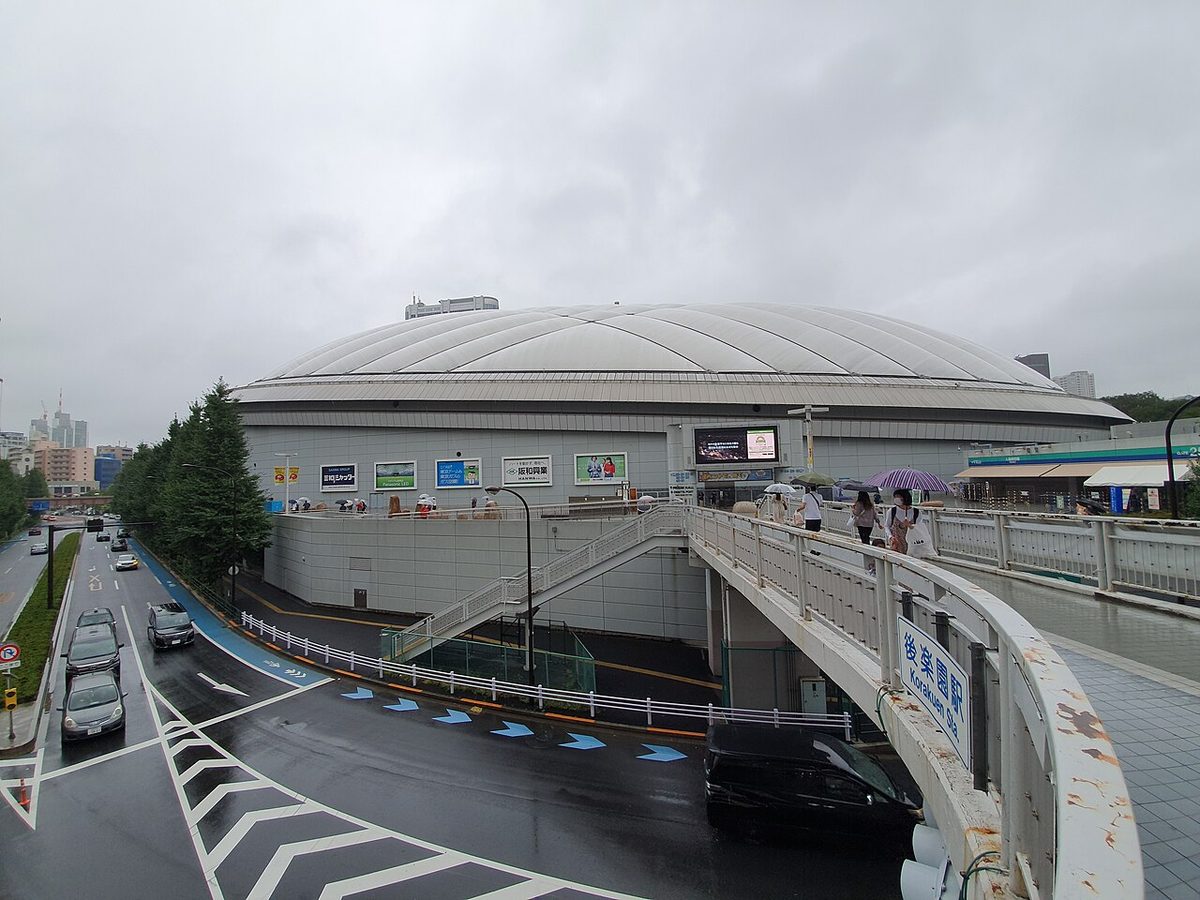
Stadiums › Tokyo Dome: History of Japan's Big Egg
Tokyo Dome is the most famous indoor ballpark in Japan. It is the home of the Yomiuri Giants. It sits in the middle of Tokyo, in a ward called Bunkyo.
It opened in 1988. It was Japan’s first domed ballpark. Its roof is held up by air. Fans gave it a nickname: the “Big Egg.”
Since then, it has seen it all. It has hosted the Japan Series and the World Baseball Classic. It has hosted MLB games and rock shows. It even hosted a famous boxing upset.
This page tells how it was built and how the roof works. It explains the odd ground rules. It covers the big games. And it gives tips for a visit. It runs through the 2025 season.
New to Japanese baseball? Read how NPB works first. For more ballparks, see our stadiums page.
Quick Facts
- Where: Bunkyo, Tokyo.
- Home team: Yomiuri Giants.
- Opened: March 17, 1988.
- Nickname: The Big Egg.
- Roof: Soft, air-supported fabric.
- Seats: Over 40,000 for baseball.
- Field: Artificial turf.
- Size: 100 meters down the lines. 122 meters to center.
- Also home to: The Japanese Baseball Hall of Fame.
Before the Dome: Korakuen Stadium
Before Tokyo Dome, the Giants played at Korakuen Stadium. It was right next door.
Korakuen opened in 1937. The Giants played there from 1938 until 1987. That is about 50 years. It held about 50,000 fans.
Korakuen saw a lot of history. Shigeo Nagashima and Sadaharu Oh played most of their home games there. So did the Giants of the V9 years, when they won nine Japan Series in a row. Read about that run on our Japan Series history page.
Other teams used Korakuen too. Over the years, it was home to six other pro teams. The Nippon-Ham Fighters were the last of them.
By the 1980s, Korakuen was old. Rain also caused many games to be called off. So a new park with a roof was planned.
Building the Big Egg
Work on Tokyo Dome began on May 16, 1985. It was built on the site of an old bicycle race track, next to Korakuen.
It took less than three years to finish. The park opened on March 17, 1988.
The next day, March 18, the Giants played the first game there. It was a preseason game against the Hanshin Tigers. The first official league game was on April 8, 1988.
After that, Korakuen was torn down. Today, a hotel and an amusement park stand where it used to be.
How the Roof Works
Here’s the thing about Tokyo Dome. The roof has no beams holding it up from below. It is held up by air.
The roof is made of a thin, soft fabric. It is a type of fiberglass. Steel cables run across it to give it shape.
Big fans blow air into the dome all the time. The air inside is pushed to a slightly higher pressure than the air outside. That small push is enough to hold the roof up. It is like a balloon.
You can feel it. When you leave through a door, a strong wind pushes you out. That is the air rushing out.
The design was based on the Metrodome in Minneapolis. That was an MLB park with an air-supported roof too.
Japanese sources say the roof weighs about 400 tons. They also say the highest point is 61.69 meters above the field. We found both numbers in Japanese sources only.
There is a fun story about that height. It comes from a long home run. Sadaharu Oh hit it in 1964. Japanese sources tell this story. The builders wanted a roof high enough for a hit like that.
Why “Big Egg”?
From the outside, the dome is white and round. It looks a bit like a giant egg. So people called it the “Big Egg.” Some called it the “Tokyo Big Egg.”
The nickname was used a lot when it opened. Today, most people just say Tokyo Dome.
The Size of the Field
Tokyo Dome is a fair size for a ballpark.
- Down the lines: 100 meters.
- To the gaps: 110 meters.
- To center field: 122 meters.
The fences are not very far for a big hitter. And the ball seems to fly well indoors. So the park has a reputation for home runs.
One Japanese source shows how much the home run rate rose over the years. In 1988, it was about 1.3 home runs a game. By 2004, it was more than 3.4 a game. Of course, the ball, the hitters and the rules all changed over that time too.
How Many Fans It Holds
Sources give different numbers for how many people the dome holds. The number also changes with each layout. A concert setup is not the same as a baseball setup.
So we will keep it simple. For baseball, Tokyo Dome holds over 40,000 fans. That makes it one of the biggest parks in Japan.
The Turf
Tokyo Dome has always had artificial turf. There is no sun inside, so real grass would not grow.
At first, it had a short, hard turf that could be rolled up. In 2002, it got a new kind of turf. It has long fake blades of grass with soft fill between them. It feels more like real grass. It is easier on the knees.
Japanese sources say Tokyo Dome was the first park in Japan to use it for games. They also say one reason was Hideki Matsui. The Giants’ star center fielder had sore knees. Read about him on our Hideki Matsui Giants page.
The turf has been replaced several times since then.
The Ceiling Rules
Here’s a question. What happens if a batted ball hits the roof?
Tokyo Dome has its own special rules for that.
- Hits the roof in fair territory: The ball is still in play. Where it lands decides if it is fair or foul. A fielder can catch it for an out.
- Hits a hanging object in the outfield: Speakers and other things hang from the roof. If a ball hits one of these over fair outfield ground, it is a home run.
- Gets stuck in the roof: Say a ball goes into a gap and does not come down. Then the batter gets two bases. That is a ground-rule double.
These rules make for some wild moments.
Famous Roof Moments
Ralph Bryant, 1990. Ralph Bryant was a big American slugger for the Kintetsu Buffaloes. On June 5, 1990, he hit a ball off the roof. It came down and was caught for an out. The next day, June 6, he hit a speaker that hung from the roof. It was ruled a home run. It was the first home run of its kind at Tokyo Dome.
Before the dome opened, Nagashima is said to have joked that no one could hit the roof. He was wrong.
Shohei Ohtani, 2016. In November 2016, Japan played the Netherlands in a practice game. Shohei Ohtani hit a huge fly ball. It went up into a gap in the roof and did not come down. It was ruled a ground-rule double.
Read more about Bryant on our page about Americans in NPB. Ohtani was born in Japan, but Bryant was an American.
Two Teams, One Dome
When Tokyo Dome opened, it had two pro teams. The Giants played there. So did the Nippon-Ham Fighters.
The Fighters had shared Korakuen with the Giants. So they moved with them in 1988. That meant Tokyo Dome had a Central League team and a Pacific League team.
In 2004, the Fighters moved to Sapporo, on the island of Hokkaido. They became the Hokkaido Nippon-Ham Fighters. Since then, Tokyo Dome has been the Giants’ home alone. Read more on our Nippon-Ham Fighters history page.
The Giants at Tokyo Dome
The Giants have won many titles while playing at Tokyo Dome. They won the Japan Series in 1989, 1994, 2000, 2002, 2009 and 2012.
The 2000 series was special. Shigeo Nagashima managed the Giants. Sadaharu Oh managed the Daiei Hawks. Fans called it the “O-N Series.” The Giants won.
The Giants play about 70 home games a year at Tokyo Dome.
For the full team story, see our Yomiuri Giants history. Read about Nagashima on our Shigeo Nagashima page.
The Japan Series at Tokyo Dome
Tokyo Dome has hosted many Japan Series games. Most were Giants home games.
In 2021, something unusual happened. The Yakult Swallows made the Japan Series. But their own park, Meiji Jingu Stadium, was booked for college games. The schedule had been pushed back because of COVID-19. So Yakult played its home games at Tokyo Dome. And they won the title. See our Yakult Swallows history.
MLB Games in Tokyo
Tokyo Dome has hosted many MLB season openers.
- 2000: The Chicago Cubs and the New York Mets. These were the first MLB regular season games ever played in Asia.
- 2004: The New York Yankees and the Tampa Bay Devil Rays. Hideki Matsui came back to Tokyo with the Yankees.
- 2008: The Boston Red Sox and the Oakland Athletics.
- 2012: The Seattle Mariners and the Oakland Athletics. Ichiro had four hits in the first game.
- 2019: The Mariners and the Athletics again. Ichiro retired after the second game.
- 2025: The Los Angeles Dodgers and the Chicago Cubs. Fans packed the dome. They came to see Japanese stars like Shohei Ohtani and Shota Imanaga.
Want more on Japanese stars in MLB? See our NPB players in MLB guide. We also have a page on Japanese pitchers in MLB.
The World Baseball Classic
Tokyo Dome has hosted games in every World Baseball Classic. The first one was in 2006.
Japan’s national team plays its first-round games there. The crowds are loud and full. Read the full story on our Japan WBC history page.
The dome has also hosted the finals of the WBSC Premier12 tournament.
The Hall of Fame
The Japanese Baseball Hall of Fame and Museum is inside the Tokyo Dome complex. It tells the story of baseball in Japan, from the first games to today.
The Hall of Fame first opened in 1959, next to Korakuen Stadium. It moved to the Tokyo Dome when the old park closed.
One famous story told there is the 1934 tour by Babe Ruth. Read about it on our 1934 tour page.
Inside, you can see plaques for the great players, old uniforms, bats, balls and more. It is a must for any fan.
More Than Baseball
Tokyo Dome is not just for baseball. It is one of the biggest event spaces in Japan.
Concerts. Many of the world’s biggest stars have played there. Mick Jagger was the first non-Japanese singer to perform there, in March 1988. Michael Jackson played there on three tours. The Rolling Stones and Paul McCartney have played there many times. Japanese pop groups play there often.
Boxing. In 1990, Mike Tyson lost to James “Buster” Douglas at Tokyo Dome. It is still called one of the biggest upsets in sports.
Other sports. The dome has hosted pro wrestling, American football, soccer, basketball and more.
Tokyo Dome City
Tokyo Dome is part of a bigger area called Tokyo Dome City. It has an amusement park with a roller coaster and a Ferris wheel. It also has a hotel, a spa, shops and places to eat.
So even if there is no game, there is plenty to do.
A Day at the Dome
What is a game like inside? Here is a quick picture.
You walk in through a revolving door. That keeps the air in. Inside, it is bright. The roof glows white above you.
The seats rise up all around the field. Fans of the Giants sit on one side. Fans of the visiting team sit on the other side, out in the outfield. Each side has its own cheering section.
The cheering never stops. Fans sing a song for each batter. They wave towels. They blow horns and beat drums. When the home team scores, the noise bounces off the roof.
In the seventh inning, fans of each team have a special time to cheer. Some teams use balloons. Ask a fan near you what to do.
There is no rain delay. There is no heat or cold. The game goes on no matter what the weather is outside.
Updates Over the Years
Tokyo Dome has been updated more than once. Big work began in 2016 and again in 2021. The work brought new screens, new lights and other changes.
The dome is now more than 35 years old. Talk of a new park for the Giants comes up from time to time. But as of the 2025 season, Tokyo Dome is still their home.
Visiting Tokyo Dome
Here are a few tips if you want to see a game.
- Getting there: Tokyo Dome is close to Suidobashi Station and Korakuen Station. It is easy to reach by train.
- Tickets: Giants games are popular. Buy early, especially for big games.
- Food: There is lots of food inside, from bento boxes to beer.
- The wind: Hold on to your hat when you leave. The air rushes out the doors.
- The Hall of Fame: Plan an hour or two to see it.
For tips on going to a game in Japan, see our NPB vs MLB guide.
How It Compares to Koshien
Japan’s two most famous ballparks are very different.
Koshien Stadium is near Osaka. It is the home of the Hanshin Tigers. It opened in 1924. It is outdoors, with real grass and a dirt infield. It also hosts the national high school tournament. Read about it on our Koshien Stadium history page.
Tokyo Dome is in Tokyo. It is the home of the Giants. It opened in 1988. It is indoors, with fake turf.
The Giants and the Tigers are big rivals. So are their fans. Read about the Tigers on our Hanshin Tigers history page.
Timeline
- 1937: Korakuen Stadium opens.
- 1959: The Hall of Fame opens next to Korakuen.
- 1985: Work on Tokyo Dome begins, May 16.
- 1988: Tokyo Dome opens, March 17. The first game is March 18. The first official game is April 8.
- 1990: Ralph Bryant hits the first home run off a hanging speaker.
- 2000: The first MLB regular season games in Asia, Cubs vs Mets.
- 2002: New, softer turf is put in.
- 2004: The Fighters move to Sapporo.
- 2006: The first World Baseball Classic games.
- 2019: Ichiro retires after a game at Tokyo Dome.
- 2021: Yakult wins the Japan Series using Tokyo Dome as its home.
- 2025: The Dodgers and Cubs open the MLB season there.
Common Questions
Who plays at Tokyo Dome? The Yomiuri Giants.
Why is it called the Big Egg? Because the white, round roof looks like a giant egg.
How is the roof held up? By air. Fans push air inside, and the extra pressure holds up the soft roof.
How many people does it hold? Over 40,000 for baseball. Sources give different exact numbers.
What happens if a ball hits the roof? It is still in play if it hits over fair ground. If it hits a hanging object over the fair outfield, it is a home run.
Is the Hall of Fame there? Yes. The Japanese Baseball Hall of Fame and Museum is at Tokyo Dome.
The Bottom Line
Tokyo Dome opened in 1988 as Japan’s first domed ballpark. Its roof is held up by air. That roof gave it the name “Big Egg.” It is the home of the Giants. It is home to the Hall of Fame too.
It has hosted the Japan Series, the WBC, MLB openers, concerts and boxing. It has strange ground rules for balls that hit the roof.
As of the 2025 season, it is still a top place to see a game. Few parks in the world are as well known.
Sources
- Wikipedia, “Tokyo Dome.” https://en.wikipedia.org/wiki/Tokyo_Dome
- Wikipedia (Japanese), “東京ドーム.” https://ja.wikipedia.org/wiki/東京ドーム
- Wikipedia, “Korakuen Stadium.” https://en.wikipedia.org/wiki/Korakuen_Stadium
- BR Bullpen (Baseball-Reference), “Tokyo Dome.” https://www.baseball-reference.com/bullpen/Tokyo_Dome