Awards › Sawamura Award: Japan's Top Pitching Prize Explained
The Sawamura Award is the top prize for a starting pitcher in Japanese pro baseball. It goes to the best starter of the year. Most years, there is just one winner for all of Japan.
It is a lot like the Cy Young Award in MLB. But it has its own rules. It looks for pitchers who go deep into games and finish what they start.
This page tells you about the man behind the name. It covers how the award began and the rules. It lists the records and every winner. It runs through the 2025 season.
New to Japanese baseball? Read how NPB works first. For more prizes, see our awards page.
Quick Facts
- What it is: The award for the best starting pitcher in NPB.
- Named for: Eiji Sawamura, a great pitcher of the 1930s.
- First given: 1947.
- First winner: Takehiko Bessho.
- Leagues: Central League only until 1988. Both leagues since 1989.
- Winners each year: Usually one. Sometimes none. Twice, two.
- Who picks: A small group of former star pitchers.
- Most wins: Three each, by five pitchers.
- 2025 winner: Hiromi Itoh of the Nippon-Ham Fighters.
Who Was Eiji Sawamura?
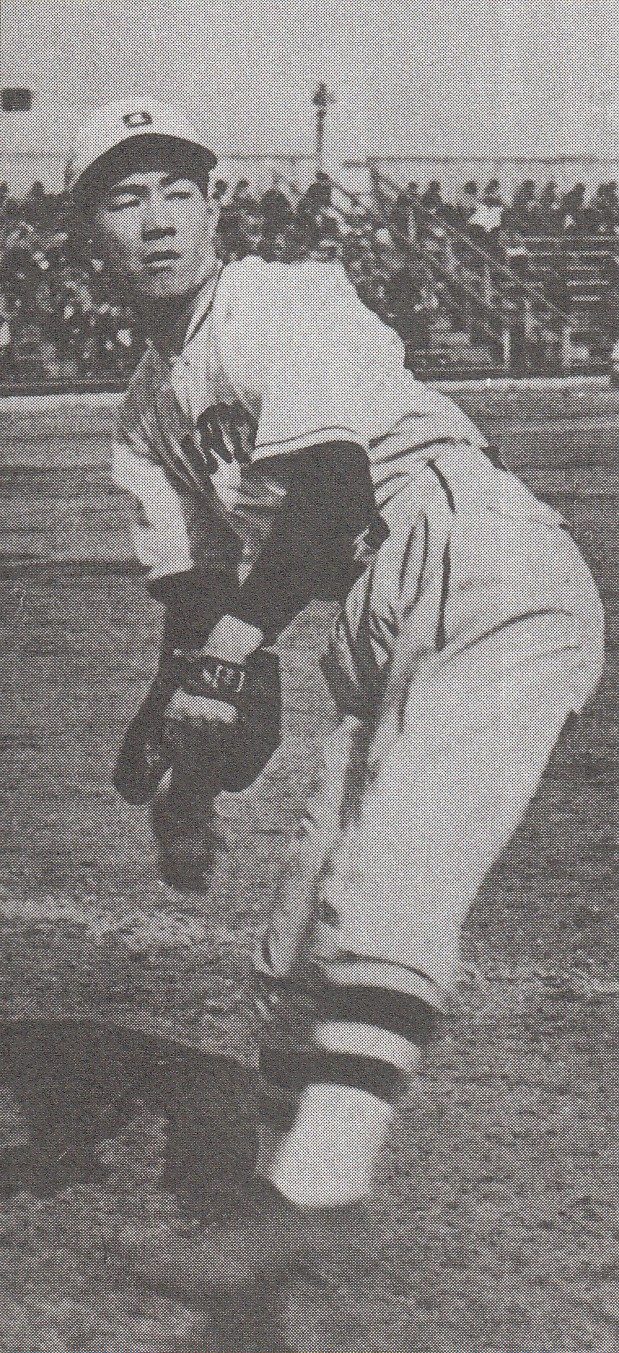
Eiji Sawamura was one of the first stars of pro baseball in Japan. He was a right-handed pitcher with a big fastball.
He became famous as a teenager. In 1934, a team of MLB stars came to Japan. Babe Ruth and Lou Gehrig were on it. Sawamura was just 17. In one game, he struck out four great hitters in a row. They were Charlie Gehringer, Babe Ruth, Lou Gehrig and Jimmie Foxx. He lost that game 1–0. Read the full story on our 1934 Babe Ruth tour page.
Then he joined the Tokyo Giants. That team is now the Yomiuri Giants. In 1936, pro baseball began in Japan. Sawamura threw the first no-hitter in the new league. It came on September 25, 1936. He threw two more. One was on May 1, 1937. The other was on July 6, 1940. In the spring of 1937, he was the first MVP. Read more on our MVP award page.
But war cut his life short. He was sent to fight in World War II. In 1944, his ship was sunk. He died at sea. He was just 27.
The Giants retired his number. It is one of only a few numbers the team has retired. Fans in Japan still honor him as a symbol of the early game. See our Yomiuri Giants history and our page on the founding of NPB.
Sawamura’s Numbers
Sawamura’s career was short. He pitched from 1937 to 1943. The army took him away more than once.
But his numbers were great. One source gives his record as 63 wins and 22 losses. It gives his ERA as 1.74. He struck out 554 batters.
In 1937, he won 33 games. His ERA was just 1.38. That was the year he was the first MVP.
He is one of only two pitchers in Japan to throw three no-hitters.
His ship was sunk on December 2, 1944. It was hit by a U.S. submarine south of Japan. More than 2,000 men died. No one lived.
How the Award Began
The award started in 1947, three years after Sawamura died.
Sources do not agree on who started it. English sources say a baseball magazine named Nekkyū set it up. Japanese sources say it was the Yomiuri Shimbun, a big newspaper. We list both, since we could not settle it.
At first, it was for complete-game pitchers. That means a pitcher who starts a game and pitches all the way to the end. Sawamura was that kind of pitcher. So the award honored that kind of work.
The first winner was Takehiko Bessho in 1947. Bessho won it again in 1955.
Only One League at First
Here’s the thing. For a long time, only Central League pitchers could win.
The league split in two in 1950. Read about it on our 1950 league split page. From 1950 to 1988, the award went only to pitchers in the Central League. A Pacific League ace could have a great year and still not be picked.
That changed in 1989. Starting that year, pitchers in both leagues could win.
The first Pacific League winner was Hideo Nomo, in 1990. He was a rookie with the Kintetsu Buffaloes. He also won the MVP and the Rookie of the Year that year. Read about him on our Hideo Nomo page.
The Seven Rules
In 1982, the award got a set of seven goals. A pitcher does not need to meet all seven. But the more he meets, the better his chances.
Here are the seven goals:
- Games pitched: 25 or more.
- Wins: 15 or more.
- Complete games: 10 or more.
- Win rate: .600 or better. That means he wins at least 6 of every 10 decisions.
- Innings pitched: 200 or more.
- ERA: 2.50 or lower. ERA means earned runs allowed for every nine innings.
- Strikeouts: 150 or more.
These goals are hard to meet. Complete games are the hardest today. Pitchers now leave games early more often than in the past.
Why the Rules Were Made
The rules came out of a fight over a pitcher named Suguru Egawa.
Egawa was a star pitcher for the Giants. Back then, sports writers picked the winner. They met as a group and voted.
In 1980, Egawa led the league in wins and strikeouts. He threw 18 complete games. But the writers gave the award to no one that year.
Then came 1981. Egawa had an even bigger year. He won 20 games. He led the league in wins, ERA, strikeouts and win rate. That is every top title for a starter. He threw 20 complete games.
Most fans thought he would win for sure. But the writers picked his teammate, Takashi Nishimoto. The vote was close. Nishimoto got 16 votes. Egawa got 13.
Why? Some writers said Nishimoto did more to help the Giants win the pennant. He had pitched well early in the year, when the team took the lead. Other writers said that was what the MVP was for. They said the Sawamura should judge the pitching alone.
People were upset. It looked like the vote was not fair. So the writers stepped away from the job. And the award was changed.
Starting in 1982, a group of former star pitchers picks the winner. There are about five of them. They use the seven goals as a guide.
What Makes a Sawamura Pitcher
So what kind of pitcher wins this award? Think of a workhorse.
He takes the ball every week. He pitches deep into the game. Often, he finishes it. He does not need a lot of help from the bullpen.
He also wins. A lot. He strikes out many batters. And he does not give up many runs.
That is a lot to ask. Many good pitchers do one or two of these things. A Sawamura winner does most of them in the same year.
Here’s a way to think about it. The MVP asks, “Who helped his team the most?” The Sawamura asks, “Who was the best at starting and finishing games?”
That is why the group sometimes picks no one. If no starter had that kind of year, they would rather skip it. They want the name to mean something.
It also helps to know how the game has changed. In the 1950s, top starters threw far more innings than they do now. Kaneda threw more than 5,500 innings in his career. That is the record in Japan. No pitcher today will come close. Today, teams use more relief pitchers. Starters often leave after six or seven innings.
So the goals that were easy in 1955 are hard now. Today, even a great ace may miss a few of them. The group knows this. It looks at the whole season, not just a checklist. That is the reason for the new goals in 2026.
Changes for 2026
The goals were changed for the 2026 season. The complete game goal went from 10 to 8. The innings goal went from 200 to 180.
This was done because the game has changed. Few pitchers throw 10 complete games now. The new goals fit the way teams use starters today.
This page covers winners through 2025. So all the winners we list were judged under the old goals.
A Newer Stat
In 2018, the group added one more thing to look at. It is like the “quality start.” Here is how the award counts one. The starter goes at least seven innings. He gives up three earned runs or fewer.
This helps the group judge pitchers who are great but do not finish many games. We found this in Japanese sources only.
Years With No Winner
Some years, the group decides no one is good enough. Then no award is given.
In 2024, no one won. The head of the group was Tsuneo Horiuchi. He had won the award twice himself. He said the Sawamura is for starters who finish their games. He said it is not just a prize for the best pitcher.
That has happened six times:
- 1971
- 1980
- 1984
- 2000
- 2019
- 2024
It shows how high the bar is. A good year is not enough. It has to be a great year.
Years With Two Winners
Twice, two pitchers shared the award.
- 1966: Minoru Murayama of Hanshin and Tsuneo Horiuchi of the Giants.
- 2003: Kei Igawa of the Hanshin Tigers and Kazumi Saito of the Daiei Hawks.
Three-Time Winners
No one has won the Sawamura Award more than three times. Five pitchers have won it three times.
- Shigeru Sugishita: 1951, 1952 and 1954, Chunichi Dragons. He was famous for the forkball.
- Masaichi Kaneda: 1956, 1957 and 1958, Kokutetsu Swallows. He won 400 games, the most ever in Japan.
- Minoru Murayama: 1959, 1965 and 1966, Hanshin Tigers.
- Masaki Saito: 1989, 1995 and 1996, Yomiuri Giants.
- Yoshinobu Yamamoto: 2021, 2022 and 2023, Orix Buffaloes.
Kaneda and Yamamoto each won it three years in a row.
Yamamoto also won the MVP and the pitching Triple Crown in those years. Then he moved to MLB with the Los Angeles Dodgers. See our page on Japanese pitchers in MLB.
Two-Time Winners
Many pitchers have won it twice. They include:
- Takehiko Bessho: 1947 and 1955.
- Tsuneo Horiuchi: 1966 and 1972.
- Kazumi Takahashi: 1969 and 1973.
- Shigeru Kobayashi: 1977 and 1979. He won with two teams, the Giants and then Hanshin.
- Manabu Kitabeppu: 1982 and 1986.
- Koji Uehara: 1999 and 2002.
- Kazumi Saito: 2003 and 2006.
- Masahiro Tanaka: 2011 and 2013.
- Kenta Maeda: 2010 and 2015.
- Tomoyuki Sugano: 2017 and 2018.
The Darvish Puzzle of 2008
In 2008, Yu Darvish met all seven goals. That almost never happens.
But he did not win. The award went to Hisashi Iwakuma of the Rakuten Eagles. Iwakuma had a great year too. He won 21 games.
It shows that the goals are a guide, not a rule. The group can pick the pitcher it thinks was best.
Darvish had won the award the year before, in 2007. Read about him on our Yu Darvish page.
Famous Winners
Many Sawamura winners became stars in MLB later.
- Hideo Nomo: 1990. He later won the NL Rookie of the Year with the Dodgers.
- Koji Uehara: 1999 and 2002. He later closed out a World Series for the Red Sox.
- Daisuke Matsuzaka: 2001. He later won a World Series with the Red Sox.
- Kenshin Kawakami: 2004.
- Yu Darvish: 2007.
- Hisashi Iwakuma: 2008.
- Kenta Maeda: 2010 and 2015.
- Masahiro Tanaka: 2011 and 2013.
- Yoshinobu Yamamoto: 2021 to 2023.
Read more on our page about NPB players in MLB.
Foreign Winners
Only two pitchers born outside Japan have won.
- Gene Bacque: 1964, Hanshin Tigers. He was from the United States.
- Kris Johnson: 2016, Hiroshima Carp. He was also from the United States.
Read about more foreign players on our page about Americans in NPB.
Teams With the Most Winners
The Yomiuri Giants have had the most winners. That makes sense. They are the oldest team. And they were in the Central League in the years when only that league could win.
Hanshin, Chunichi and Hiroshima have also had many winners.
One team has never had a winner. That is the Chiba Lotte Marines. One reason is simple. Lotte has always been in the Pacific League. For 39 years, that league was left out.
The 2025 Winner
The 2025 award went to Hiromi Itoh of the Hokkaido Nippon-Ham Fighters. The year before, in 2024, no one was picked.
Every Winner, 1947 to 2025
Here is the full list of winners. Teams are listed by the name they used that year.
| Year | Winner | Team |
|---|---|---|
| 1947 | Takehiko Bessho | Nankai Hawks |
| 1948 | Hiroshi Nakao | Yomiuri Giants |
| 1949 | Hideo Fujimoto | Yomiuri Giants |
| 1950 | Shigeo Sanada | Shochiku Robins |
| 1951 | Shigeru Sugishita | Chunichi Dragons |
| 1952 | Shigeru Sugishita | Chunichi Dragons |
| 1953 | Takumi Otomo | Yomiuri Giants |
| 1954 | Shigeru Sugishita | Chunichi Dragons |
| 1955 | Takehiko Bessho | Yomiuri Giants |
| 1956 | Masaichi Kaneda | Kokutetsu Swallows |
| 1957 | Masaichi Kaneda | Kokutetsu Swallows |
| 1958 | Masaichi Kaneda | Kokutetsu Swallows |
| 1959 | Minoru Murayama | Hanshin Tigers |
| 1960 | Ritsuo Horimoto | Yomiuri Giants |
| 1961 | Hiroshi Gondo | Chunichi Dragons |
| 1962 | Masaaki Koyama | Hanshin Tigers |
| 1963 | Yoshiaki Ito | Yomiuri Giants |
| 1964 | Gene Bacque | Hanshin Tigers |
| 1965 | Minoru Murayama | Hanshin Tigers |
| 1966 | Minoru Murayama | Hanshin Tigers |
| 1966 | Tsuneo Horiuchi | Yomiuri Giants |
| 1967 | Kentaro Ogawa | Chunichi Dragons |
| 1968 | Yutaka Enatsu | Hanshin Tigers |
| 1969 | Kazumi Takahashi | Yomiuri Giants |
| 1970 | Masaji Hiramatsu | Taiyo Whales |
| 1971 | Not awarded | — |
| 1972 | Tsuneo Horiuchi | Yomiuri Giants |
| 1973 | Kazumi Takahashi | Yomiuri Giants |
| 1974 | Senichi Hoshino | Chunichi Dragons |
| 1975 | Yoshiro Sotokoba | Hiroshima Toyo Carp |
| 1976 | Kojiro Ikegaya | Hiroshima Toyo Carp |
| 1977 | Shigeru Kobayashi | Yomiuri Giants |
| 1978 | Hiromu Matsuoka | Yakult Swallows |
| 1979 | Shigeru Kobayashi | Hanshin Tigers |
| 1980 | Not awarded | — |
| 1981 | Takashi Nishimoto | Yomiuri Giants |
| 1982 | Manabu Kitabeppu | Hiroshima Toyo Carp |
| 1983 | Kazuhiko Endo | Yokohama Taiyo Whales |
| 1984 | Not awarded | — |
| 1985 | Tatsuo Komatsu | Chunichi Dragons |
| 1986 | Manabu Kitabeppu | Hiroshima Toyo Carp |
| 1987 | Masumi Kuwata | Yomiuri Giants |
| 1988 | Yutaka Ohno | Hiroshima Toyo Carp |
| 1989 | Masaki Saito | Yomiuri Giants |
| 1990 | Hideo Nomo | Kintetsu Buffaloes |
| 1991 | Shinji Sasaoka | Hiroshima Toyo Carp |
| 1992 | Takehiro Ishii | Seibu Lions |
| 1993 | Shinji Imanaka | Chunichi Dragons |
| 1994 | Masahiro Yamamoto | Chunichi Dragons |
| 1995 | Masaki Saito | Yomiuri Giants |
| 1996 | Masaki Saito | Yomiuri Giants |
| 1997 | Fumiya Nishiguchi | Seibu Lions |
| 1998 | Kenjiro Kawasaki | Yakult Swallows |
| 1999 | Koji Uehara | Yomiuri Giants |
| 2000 | Not awarded | — |
| 2001 | Daisuke Matsuzaka | Seibu Lions |
| 2002 | Koji Uehara | Yomiuri Giants |
| 2003 | Kei Igawa | Hanshin Tigers |
| 2003 | Kazumi Saito | Fukuoka Daiei Hawks |
| 2004 | Kenshin Kawakami | Chunichi Dragons |
| 2005 | Toshiya Sugiuchi | Fukuoka SoftBank Hawks |
| 2006 | Kazumi Saito | Fukuoka SoftBank Hawks |
| 2007 | Yu Darvish | Hokkaido Nippon-Ham Fighters |
| 2008 | Hisashi Iwakuma | Tohoku Rakuten Golden Eagles |
| 2009 | Hideaki Wakui | Saitama Seibu Lions |
| 2010 | Kenta Maeda | Hiroshima Toyo Carp |
| 2011 | Masahiro Tanaka | Tohoku Rakuten Golden Eagles |
| 2012 | Tadashi Settsu | Fukuoka SoftBank Hawks |
| 2013 | Masahiro Tanaka | Tohoku Rakuten Golden Eagles |
| 2014 | Chihiro Kaneko | Orix Buffaloes |
| 2015 | Kenta Maeda | Hiroshima Toyo Carp |
| 2016 | Kris Johnson | Hiroshima Toyo Carp |
| 2017 | Tomoyuki Sugano | Yomiuri Giants |
| 2018 | Tomoyuki Sugano | Yomiuri Giants |
| 2019 | Not awarded | — |
| 2020 | Yūdai Ōno | Chunichi Dragons |
| 2021 | Yoshinobu Yamamoto | Orix Buffaloes |
| 2022 | Yoshinobu Yamamoto | Orix Buffaloes |
| 2023 | Yoshinobu Yamamoto | Orix Buffaloes |
| 2024 | Not awarded | — |
| 2025 | Hiromi Itoh | Hokkaido Nippon-Ham Fighters |
How It Compares to the Cy Young
The Sawamura Award and the Cy Young Award are both for top pitchers. But they differ in a few ways.
- One or two. MLB gives one Cy Young in each league. Japan usually gives one Sawamura for both leagues.
- Who picks. Writers vote for the Cy Young. Former pitchers pick the Sawamura.
- No winner. The Cy Young is always given. The Sawamura can be skipped.
- Starters only. The Sawamura is for starters. Relief pitchers have won the Cy Young.
For more on how the two games differ, see our NPB vs MLB guide.
Prize Money
Japanese sources say the winner gets a cash prize of 3 million yen. We found this in one source only.
Key Terms
- Starting pitcher: The pitcher who begins the game.
- Complete game: When the starter pitches the whole game.
- ERA: Earned runs allowed for every nine innings.
- Win rate: Wins divided by wins plus losses.
- Innings pitched: How many innings a pitcher threw.
- Quality start: A start where the pitcher goes deep and gives up few runs.
See more in our glossary.
Common Questions
What is the Sawamura Award? It is the award for the best starting pitcher in Japan.
Who was Eiji Sawamura? He was a star pitcher in the 1930s. He struck out Babe Ruth in 1934. He died in World War II.
Who has won it the most? Five pitchers have won it three times. They are Sugishita, Kaneda, Murayama, Masaki Saito and Yoshinobu Yamamoto.
Can Pacific League pitchers win? Yes, since 1989. Before that, only Central League pitchers could win.
Is it given every year? No. Six times, no one was picked. The last time was 2024.
Who won in 2025? Hiromi Itoh of the Nippon-Ham Fighters.
The Bottom Line
The Sawamura Award honors the best starting pitcher in Japan. It is named for a young ace who died in the war. It looks for pitchers who win, strike out batters and finish what they start.
It is hard to win. Some years, no one does. Only five pitchers have won it three times.
As of the 2025 season, the latest winner is Hiromi Itoh. To see who led each league in wins, ERA and strikeouts, visit our title holders page.
Sources
- Wikipedia, “Eiji Sawamura Award.” https://en.wikipedia.org/wiki/Eiji_Sawamura_Award
- Wikipedia (Japanese), “沢村栄治賞.” https://ja.wikipedia.org/wiki/沢村栄治賞
- Wikipedia, “Eiji Sawamura.” https://en.wikipedia.org/wiki/Eiji_Sawamura
- BR Bullpen (Baseball-Reference), “Sawamura Award.” https://www.baseball-reference.com/bullpen/Sawamura_Award
- SABR, “The 1934 Tour of Japan” (Robert K. Fitts). https://sabr.org/journal/article/the-1934-tour-of-japan/